How Old Do I Look? AI Age Guesser from Your Photo
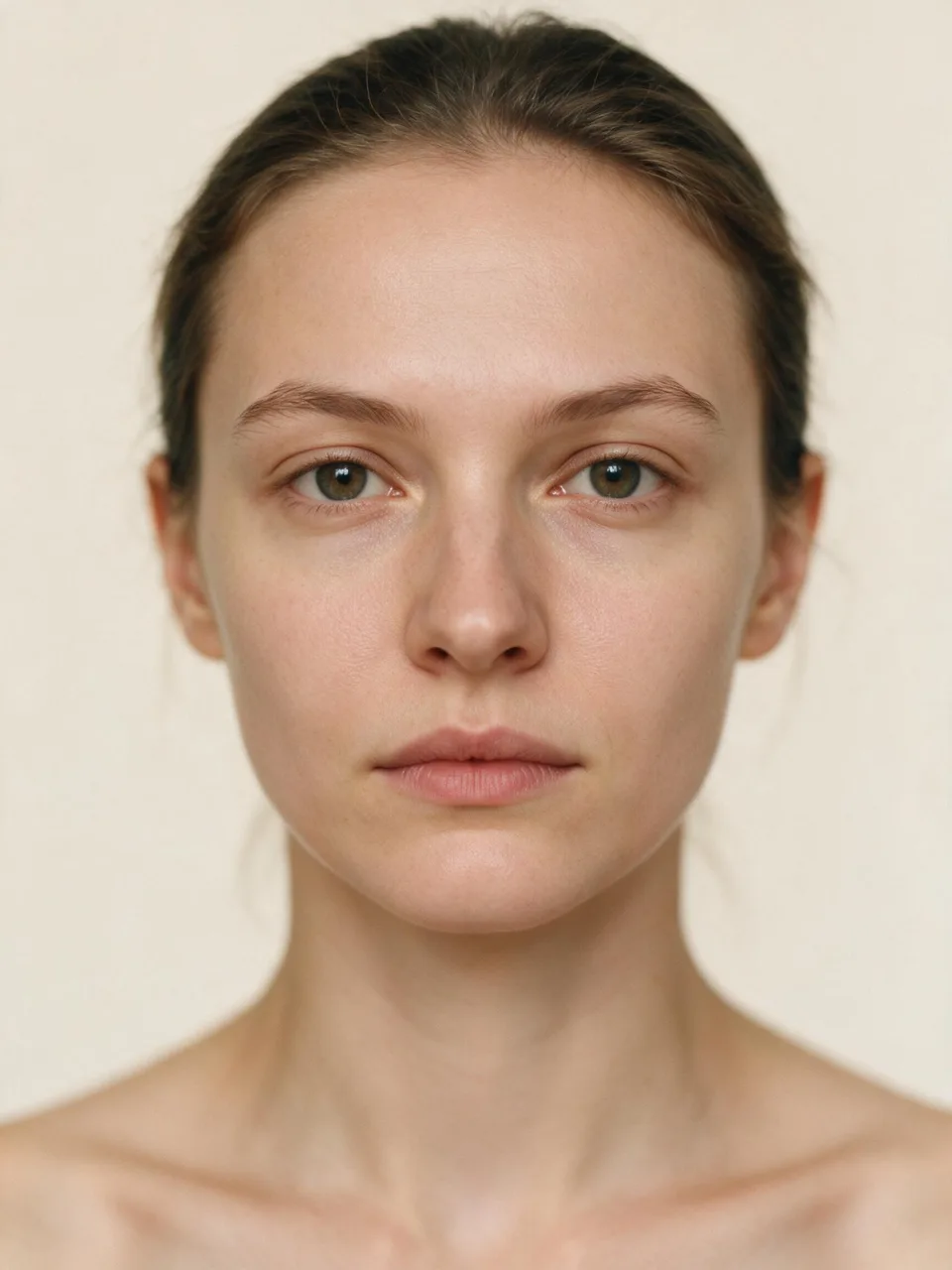
EXAMPLE ANALYSIS: 478 LANDMARKS MAPPED ON A SAMPLE PHOTO, NOT YOURS.
What a reading looks like
Real components · sample dataA starting line, not a verdict.
What we won't show you: a confidence band (not until our test-retest study ships) · a percentile (not until a reference population is published) · a skin score from one photo (lighting lies). Every "not scored" comes with its reason.
Apparent age is estimated from three signals - skin texture, facial contrast and soft-tissue volume - and typically lands within about four years of chronological age.
This AI facial analysis returns a single age estimate, a range or confidence label, and a factor breakdown, never a birth-certificate fact.
The Short Version
An age estimate is a perception model, and this page treats it as one. The reading is a secondary, non-clinical line: useful for seeing what a camera takes from skin texture, eye area and jaw framing, and never presented as a fact about your body.
How Old Do You Look? What This Estimate Answers
An AI age guesser reads one photo for skin texture, facial contrast and soft-tissue volume, then returns a single apparent age rather than a fact about your actual birth date.
Whether the search is "how old do I look" or its reordered twin, "how old I do look," the underlying question and the answer stay the same. The estimate reflects this one photo, read for the day's lighting, expression and angle, not an average of how a face looks across time. It is not a diagnosis, a legal age check or a fact pulled from any record. A single image cannot capture every day of a face, so the number is best read as one data point, not a verdict.
What the AI Actually Reads: Texture, Contrast, and Volume
Three visible signals, measured on your device, build the estimate: skin texture, facial contrast and soft-tissue volume. Each is a real, measurable property of a photo, and each is tied below to the published research behind it, not an uncited guess.
Skin texture
Skin texture is the model's read of fine lines, pore pattern and surface smoothness across the cheeks, forehead and under the eyes. Nkengne and Bertin's clinical review of facial skin aging documents these exact changes, fine wrinkles, coarser texture and reduced smoothness, as visible age markers. Cula and colleagues' automatic wrinkle-detection method quantifies the same surface changes from a photograph, the computer-vision basis this signal builds on. Texture is the most resolution-sensitive of the three signals.
Facial contrast
Facial contrast is the difference in color and brightness between the eyes, lips and eyebrows and the surrounding skin. Porcheron and colleagues measured facial contrast across four ethnic groups and found it decreases with age and independently affects how old a face is judged to look, regardless of ethnicity. A higher facial contrast reads as younger, which is also why cosmetics and some photo filters shift the estimate without changing the face underneath.
Soft-tissue volume
Soft-tissue volume is how fat and supportive tissue are distributed across the cheeks, temples and jaw. Guyuron and colleagues' twin study documented loss of cheek and temple volume alongside jowl gain along the jawline, read here from the same 478-point facial mesh every tool on this site already uses. Ichibori and colleagues replicated the same environmental aging pattern in a separate population. Volume shift is the slowest of the three signals to change.
Your Estimate and Its Range: Reading the Result Honestly
This age guesser prints a numeric range only when a published validation study supports its width, and a confidence label instead of a number whenever that validation does not yet exist.
Most age-guessing tools print a number they cannot defend: a stated accuracy that contradicts itself between the page and its own schema, or a confidence score with no explanation of what the percentage measures. This tool takes the opposite approach and publishes an honest range only where the validation behind it is real. The width of any displayed range comes from testing the model against a labelled, demographically diverse set of photos with known ages. That methodology, including sample size, demographic makeup and the resulting error distribution, is published on the site's methodology page under the current model version.
Until that validation exists for a given signal, the tool shows the point estimate plus a qualitative confidence label rather than inventing a range. "High confidence" means none of the photo-quality checks flagged a problem. "Moderate" or "lower confidence" name the specific issue, such as uneven lighting or a steep angle, rather than asserting a vague score alone.
Why Your Estimate Might Not Match Your Actual Age
A gap between how old a face looks and a person's actual age is normal, and it is measurable rather than subjective. A large Danish cohort study by Christensen and colleagues treats perceived age as a real biomarker of aging tracked across a population, not a vanity metric. The open AgeGuess database, built from chronological-versus-perceived-age guesses on people aged 5 to 100, confirms the same gap exists at scale. Steiner and colleagues found that perceived age tracks population-level life-expectancy trends over time.
Guyuron and colleagues' twin study isolates the strongest individual factors, comparing identical twins to control for genetics. Smoking is the single largest driver of looking older, with an effect so consistent across twin pairs that the result is statistically decisive at p less than 0.0001. Sun exposure produces a smaller but still real effect, at p equal to 0.015, and hormone use shows its own measurable shift, at p equal to 0.002.
Sleep restriction shows up the same way in controlled research. Holding and colleagues, and separately Sundelin and colleagues, found that after short, restricted sleep, independent observers rated faces as less healthy-looking and more fatigued, a subjective judgment with an objective, measured cause.
The most counter-intuitive finding involves body weight. The same twin-study data found a four-point increase in BMI reads as older in people under 40, but reads as younger after 40, at a comparable effect size in both directions. None of these factors move an estimate instantly, but each has a real, cited, and sometimes surprising effect.
Is This a Medical or Biological Age Test?
No, this consumer age estimate is not a medical or biological age test, and it makes no health claim of any kind.
A real, peer-reviewed clinical instrument reads some of the same kind of signal at far greater depth. Bontempi and colleagues trained a deep-learning system called FaceAge on 58,851 patients and published the results in the Lancet Digital Health in 2025. The system found that a face's estimated biological age predicts cancer survival independent of chronological age.
That is genuine, prestigious clinical research, and it is not what this page delivers. This tool is a consumer estimate built for curiosity, not diagnosis, and it never returns a health, disease-risk or life-expectancy conclusion about the person in the photo.
How Old Do I Look: vs. Filters, ChatGPT, and Other Ways to Guess
Beauty filters and heavy retouching raise facial contrast, and Porcheron's research on facial contrast found that higher contrast reads as younger. A filter can shave years off a photo. It has never shaved a year off the face underneath. The estimate reacts to the filter. The calendar does not.
Asking the ChatGPT attractiveness test, and what it actually does is a genuinely different method, not a worse one by default. ChatGPT reasons over a written description of an image using a language model, while this tool reads pixel-level texture, contrast and geometry with a trained vision model. The two can disagree because they are measuring different things in different ways, not because one tool is simply smarter.
Humans guessing age from a photo are the original baseline every automated method is compared against. The AgeGuess project collected human age guesses on photos of people aged 5 to 100, and even trained human observers miss real age by several years on average. If a single estimate like this one has you wondering how attractive am I, really, the full attractiveness test reads every visible signal at once instead of one.
What This Estimate Cannot Tell You
The full range derivation lives on how we measure, and where the measurement fails.
Where Does an Honest Answer Leave You?
The estimate's account is complete: what it reads, how honest the range is, and what it cannot tell you. The number itself is still sitting with you, and what happens next is the more useful question.
How to confirm it
- Retake the photo in even, front-facing light.
- Keep a neutral to slight-smile expression, and skip filters entirely.
- Compare the new estimate with the first one instead of fixating on either single result.
What it changes
Sleep, sun protection and quitting smoking are the factors with a measured, named effect on perceived age. Holding and colleagues, and separately Sundelin and colleagues, found that after restricted sleep, observers rated faces as less healthy-looking and more tired. Guyuron's twin study found smoking's effect on looking older to be one of the strongest and most consistent in the whole dataset. These are evidence-ranked, not styling advice.
What it does not change
Chronological age itself does not change, and no photo adjustment moves a birth date. The estimate is also not a measure of health, aging speed or life expectancy on its own, the same boundary stated earlier for the clinical research this method draws on. The ceiling here is honesty, not correction.
Is the Age Guesser Accurate?
Yes, the age guesser is reproducible: the same photo and the same model version return the same estimate every time, which is a narrower claim than being exactly right about your real age.
Reproducibility and correctness are two different claims, and this page only makes the first one without inflating it into the second. Running the identical photo through the identical model version returns the identical estimate, which confirms the tool is stable, not that any single number is correct about a specific person's real age. For the full statistical treatment, see the method, the version and the range derivation.
More Ways to Measure Your Face
Apparent age is one of several visible signals this site reads on their own. Your jawline rating measures a different, structural signal, jaw and chin geometry rather than skin, contrast or volume, using the same on-device approach.
For the full picture in one pass, analyse your whole face and get every metric, including this one, scored together instead of one at a time.
Not medical advice. This is an estimate of how old a photo looks, not a diagnosis, a clinical assessment, or a verdict on you.
It measures geometry, not worth. The number tells you where you start. It never tells you what you are.
on every page
of this site
Your report, in full.
- Side profile
- Skin, measured properly
- Averageness
- Dimorphism
- Ranked plan
Paid photo deleted within 24 hours · never used for training
- 40+ measurements, 7 regionsPP. 2-9
- Side profile, from a second photoPP. 10-13
- What moved your score, rankedPP. 14-16
- Four week plan and day 30 re-scanPP. 17-20
Frequently Asked Questions
How accurate is an AI age guesser?
This age guesser shows a numeric range only when a published validation study supports it, and a confidence label when one does not yet exist. It never prints an accuracy percentage it cannot trace to a real methodology.
Why do I look older or younger than my actual age?
Photos often show a face that reads older or younger than actual age because sleep, sun exposure and smoking each measurably shift the visible signals the estimate reads. Twin studies isolate these effects with real, statistically significant differences, not vague lifestyle advice.
Does my photo get uploaded when I use the age guesser?
No, both of the age guesser's models run in your browser, so photos never leave your browser and nothing is uploaded, stored or used for training. You can verify this yourself in your browser's network tab, or read the full privacy policy for exactly what is and is not transmitted.
Does the age estimate work the same for every skin tone and ethnicity?
No facial-analysis model performs identically across every skin tone, and this age guesser is no exception. The known limits of the training data and the site's policy on bias and excluded uses are published in our AI policy on bias and excluded uses.
Can ChatGPT guess my age from a photo?
ChatGPT can guess age from a description of a photo, but it reasons over language rather than reading pixel-level signals the way a trained vision model does. That structural difference, not one tool being smarter than the other, is why estimates from the two methods can differ.
Is this the same as an age-verification app?
No, age verification checks a person's identity or legal age for access control, while this tool estimates how old a photo looks. The two solve completely different problems and use different technology entirely.
Is this a real biological age or health test?
No, this consumer tool is not a biological age or health test. It is inspired by peer-reviewed clinical research on facial aging, including a Lancet Digital Health study on cancer prognosis, but it makes no health claim of any kind.
What can I actually do about how old I look in photos?
Sleep, sun protection and quitting smoking are the only factors in the cited research with a measured effect on perceived age. None of them change an estimate instantly, and no single photo adjustment does either.
Does a filter change my actual age or just the estimate?
A filter changes only the estimate, not the age underneath it. Filters and heavy retouching raise facial contrast, which independently reads as younger regardless of a person's real age.
References
Every claim above, traceable
- Bontempi et al., Lancet Digital Health 2025 - a deep-learning system called FaceAge, trained on 58,851 patients, found that estimated biological age from a face photograph predicts cancer survival independent of chronological age.
- Christensen et al., BMJ 2009 - perceived age from a photograph is a clinically useful biomarker of aging in a large Danish cohort study.
- Porcheron et al., Frontiers in Psychology 2017 - facial contrast is a cross-cultural cue for perceiving age, decreasing with age across four ethnic groups.
- Nkengne and Bertin, Skinmed 2013 - a clinical review documenting the visible signs of facial skin aging, including fine wrinkles and reduced smoothness.
- Cula et al., Skin Research and Technology 2013 - automatic detection and quantification of facial wrinkles from photographs, the computer-vision basis for texture reading.
- Guyuron et al., Plastic and Reconstructive Surgery 2009 - a twin study finding smoking (p<0.0001), sun exposure (p=0.015), hormone use (p=0.002) and a nonlinear BMI-by-age-band pattern (p=0.0001) each measurably shift how old identical twins look.
- Ichibori et al., Journal of Cosmetic Dermatology 2014 - objective assessment of facial skin aging and its environmental factors in Japanese monozygotic twins, replicating the pattern in a separate population.
- Jones et al., Scientific Data 2019 - the AgeGuess database, an open resource of chronological and perceived ages of people aged 5 to 100.
- Steiner et al., The Journals of Gerontology Series A 2020 - perceived age and life expectancy show parallel progress across a population.
- Holding et al., Journal of Sleep Research 2019 - the effect of sleep deprivation on objective and subjective measures of facial appearance.
- Sundelin et al., Royal Society Open Science 2017 - restricted sleep has negative effects on facial appearance and social appeal.