AI Jawline Rating: How Defined Is Your Jawline?
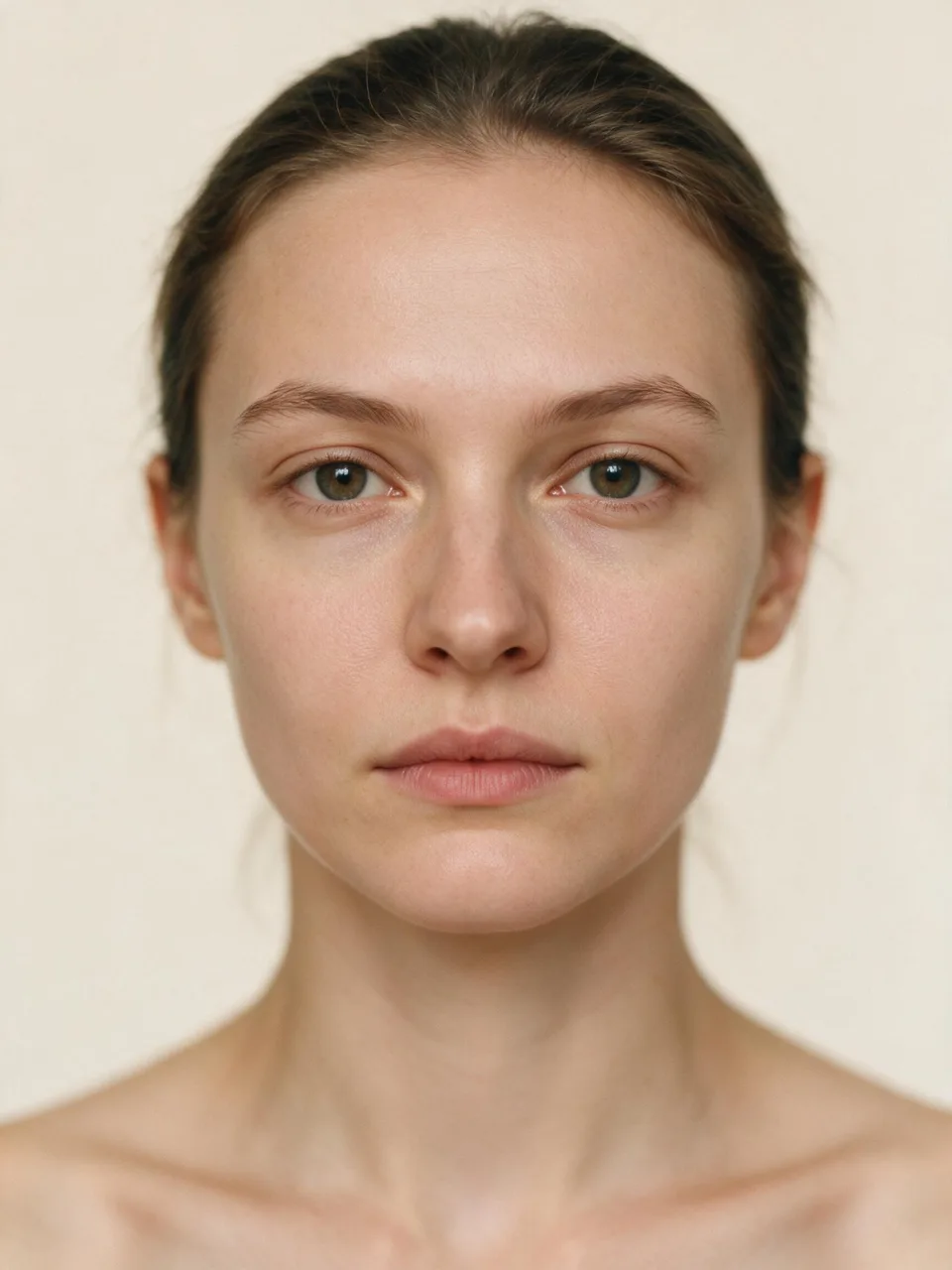
EXAMPLE ANALYSIS: 478 LANDMARKS MAPPED ON A SAMPLE PHOTO, NOT YOURS.
What a reading looks like
Real components · sample dataA starting line, not a verdict.
What we won't show you: a confidence band (not until our test-retest study ships) · a percentile (not until a reference population is published) · a skin score from one photo (lighting lies). Every "not scored" comes with its reason.
Jawline definition is read from the gonial angle, the angle between the jaw body and the ascending ramus, where roughly 120 degrees reads as sharp and 130 or more reads as soft.
This AI facial analysis measures your gonial angle from one photo, analyzed on your device, and reports a published Sharp, Average, or Soft band. The result describes geometry in one photograph, not a verdict.
The Short Version
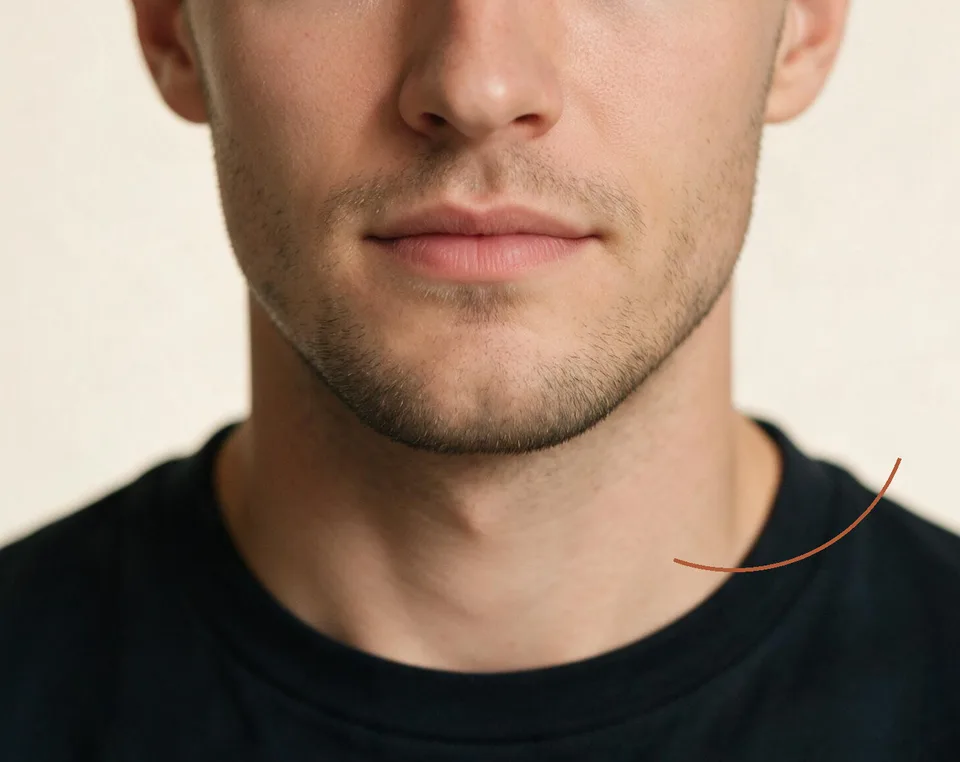
A front photo supports a jaw contour estimate, not a clinical gonial angle, and the page treats that difference honestly: the arc shows what the landmarks can actually trace, and the reading carries the confidence the geometry supports rather than a number dressed up as radiography.
What Is a Jawline Rating?
A jawline rating measures the angle at the corner of your jaw from a photo and reports it in degrees, alongside a plain-language band.
The measured point is the gonial angle, the angle between your jaw's body, the horizontal bone beneath your chin and cheek, and its ascending ramus, the bone that rises toward your ear. The two lines meet at the gonion, the corner point of your jaw. A narrower angle reads as a sharper, more defined jawline. A wider angle reads as softer or rounder. Jaw definition and lower-face contour both name the same geometry this angle measures.
How Your Jawline Is Measured: The Gonial Angle
The angle is calculated from the line along your jaw's ramus and the line along its body, measured where they meet at the gonion. You can trace the same lines yourself with a photo and a protractor. This tool fits a 478-point landmark mesh to your photo in your browser and finds the ramus and body lines at each side of your jaw. It corrects both lines against your face's horizontal axis, so a tilted head does not skew the reading. It reports the angle per side, then averages the two, with every point rendered on the photo itself so you can check the lines against your own jaw.
- Take a straight-on photo with your jaw relaxed, not clenched.
- Find the gonion, the point where your jaw turns from body to ramus, on each side.
- Trace a line along the jaw body and a second line along the ascending ramus at each gonion.
- Measure the angle between the two lines with a protractor against a printed reference diagram.
This is a 2D estimate projected from your photo, not the lateral X-ray measurement orthodontics uses to find the true gonial angle. Most jawline apps charge a monthly subscription to hide this exact math; a protractor and five minutes do the same job for the price of a protractor. Photos never leave your browser while either method runs.
Sharp, Average, or Soft: What the Angle Bands Mean
A gonial angle near 120 degrees reads as a sharp, angular jawline; one at 130 degrees or more reads as soft or rounded, and most faces fall somewhere between the two.
| Band | Approx. angle | What it looks like | Real query terms it answers |
|---|---|---|---|
| Sharp | 120 degrees or narrower | A pronounced, angular corner at the jaw | strong jawline, sharp jawline, chiseled jawline, tight jawline |
| Average | 121 to 129 degrees | A moderate corner, neither pronounced nor soft | jawline rating, jawline checker, jawline test |
| Soft | 130 degrees or wider | A rounder, less pronounced corner | recessed jawline, weak jawline, no jawline, soft jawline |
These three bands are published under Jaw v1.0, with the exact degree thresholds fixed before this page went live. Each band is a description of geometry: a Sharp corner reads as more angular, a Soft corner reads as more rounded, and most faces measure somewhere in between, in the Average band. Recessed, weak, no jawline, strong, sharp, chiseled, and tight all describe points along this same spread. None of these words is a verdict on a specific face; they are population language for a curve most people sit somewhere across, not at either end.
Jawline Definition in Men and Women
The measurement literature more often finds narrower, more acute gonial angles in men and wider, more obtuse ones in women, though the two most detailed studies used different methods on different populations. A mandibular morphometry study measured with CT imaging found the gonial angle significantly wider in women than in men [5]. A separate study of white celebrity faces measured the same direction from photograph landmarks instead of a CT scan [1]. The two studies used different imaging methods on different populations. Together they license a direction, not a single combined number for the male or female gonial angle.
What the Evidence Says About Jawline and Attractiveness
The strongest pattern in this literature is the sex difference already detailed above: gonial angle measures narrower in men and wider in women, across two independently measured samples using different imaging methods [5][1]. That direction is the best-supported finding in this section; the exact number is not, because CT imaging and photograph landmarking are not the same measurement.
The closest research to a good jaw angle is a preference survey, not a clinical standard. An online survey on the ideal female jaw angle found raters favored roughly 125.5 degrees measured in profile and roughly 142 degrees measured from the front, two different readings from the same study [2]. A separate psychometric comparison scored rated beauty against female jaw angles with its own method [3]. A study of the lower facial third measured an attractive range of about 84.5 to 91.5 degrees, using a different angle definition than either of those [4]. These three figures describe three different measurement conventions, not one number for the ideal gonial angle.
A wider jaw does not reliably read as more attractive on men. A geometric morphometrics study of male facial shape found the most attractive men in its sample had longer, narrower jaws, while wider jaw outlines tracked with perceived strength and dominance instead of attractiveness [7]. The common assumption that a broader jaw reads as more masculine and more attractive holds for perceived strength, not for rated attractiveness.
The gonial-angle range this page treats as typical is itself a sample-specific convention, not a universal constant. A cephalometric study of a Pakistani adult sample measured a different typical range than the values commonly cited from other populations [8]. Population matters to what counts as an average angle in the first place.
No published study ranks how rare any single gonial-angle class is. The rarity question behind searches like it behaves like a real question with no real dataset behind it. The closest evidence remains the preference-survey range above [2] and the population comparison just given [8], and neither measures rarity. The honest answer is that no such dataset exists yet, not a fabricated percentile.
Can You Actually Change Your Gonial Angle?
The gonial angle is bone, and bone does not respond to chewing gum or facial exercise in an adult.
- Photo variables that change fastest and mean least: lighting, camera height, expression, and grooming, all cosmetic, changing nothing about your bone.
- Claims that do nothing to the angle: chewing gum, jaw exercises, and jawline trainer devices, which build the masseter beside your jawbone without moving the bone itself [6].
- The one hard boundary: jaw surgery, out of scope here, a question for a maxillofacial specialist, not a photo tool.
The jawline exercises that actually change definition and the chewing-gum jawline claim, checked against the evidence, both get a full claim-by-claim breakdown on their own dedicated pages, not repeated here.
What This Score Cannot Tell You
This page returns an angle and a band, not a score, and that distinction sets the limit on everything below it.
How Does This One Metric Feed the Overall Attractiveness Score?
The measurement's account of your jaw is complete: an angle, a band, and the limits above it. What is still open is where that one number sits inside a full attractiveness read, whether the rating itself is reproducible, and what, if anything, changes it over time. One term worth naming here since it never gets its own heading: jawline drop is the informal name some searches use for the same soft-band geometry this page already measures, not a separate condition.
The score bands
A gonial angle near 120 degrees sits at the sharp end of the range, not a pass-or-fail threshold, and most measured jaws fall across a spread rather than landing on one exact number. The Sharp, Average and Soft bands above describe geometry, not what a 1-10 attractiveness score really means for your face specifically. A jaw band is one input the site's broader analysis weighs alongside everything else it measures, so reading it against a full score answers a different question than reading the angle alone.
The accuracy question: is this rating legit?
This rating is reproducible, the same photo and the same version return the same angle, which is a narrower claim than being certain about the number on a different day's photo. The widget refuses to return an angle at all when your photo falls outside its stated pose tolerance or a beard obscures the jaw line, naming the reason rather than guessing anyway. It also states plainly, every time, that this is a 2D estimate projected from a photo, not the lateral X-ray measurement clinicians use. No validation study has been run against a clinical reference yet, so no accuracy percentage is published here, stated as a fact rather than an apology. The classification rule and the version tag behind every band are public, dated, and versioned as Jaw v1.0.
What actually changes it
Nothing you do on purpose moves the bone: not chewing gum, not jaw exercises, not a jawline trainer device, each of which works the masseter muscle beside your jawbone rather than the bone itself [6]. The one thing that genuinely does move the number is age. Ordinary bone remodeling shifts the gonial angle slowly over decades, in a documented, sex-differentiated pattern, distinct from anything a routine changes on purpose [6]. A single measurement here answers what your jaw looks like in one photo, not what the rest of your face is doing. Your Attractiveness Report measures the lower face in full context, not one angle in isolation.
Where Your Jawline Fits in the Full Analysis
The same 478-point mesh that read your jaw also runs the composite scan behind the rest of the site. Analyse your whole face reports every measurement with its own unit and its own tolerance, rather than folding your jaw into one blended number.
A side-profile scan reports a related but different angle, the submental-cervical angle from your side profile, the line under your chin and down your neck rather than the corner of your jaw. The two measurements describe different parts of the same lower face.
For the full picture rather than one metric, test your whole face, not just this one metric: the site's namesake instrument turns every measurement including this one into a single interpretable score.
Jawline Exercises, Mewing, and the Chewing-Gum Claim
Jaw exercises, mewing, and the chewing-gum claim are usually asked about as one family, and they share a single mechanism: each one targets the masseter muscle or oral posture, not the bone this page measures. That single sentence is the honest summary; the full evidence grading for each claim lives on its own dedicated page, evaluated in full rather than repeated here. The jawline exercises that actually change definition and the chewing-gum jawline claim, checked against the evidence, both go through the same claim-by-claim treatment the section above already previewed. A related styling question, the beard styles that balance your jaw width, uses your measured jaw width as a starting input rather than claiming to change the angle itself.
Not medical advice. This is a measurement of a photo, not a diagnosis, a clinical assessment, or a verdict on you.
It measures geometry, not worth. The number tells you where you start. It never tells you what you are.
on every page
of this site
Your report, in full.
- Side profile
- Skin, measured properly
- Averageness
- Dimorphism
- Ranked plan
Paid photo deleted within 24 hours · never used for training
- 40+ measurements, 7 regionsPP. 2-9
- Side profile, from a second photoPP. 10-13
- What moved your score, rankedPP. 14-16
- Four week plan and day 30 re-scanPP. 17-20
Frequently Asked Questions
Is a 120 degree jawline good?
A gonial angle near 120 degrees sits at the sharp end of the measured range, not a pass-or-fail threshold. Most measured jaws fall across a spread rather than landing on one exact number, so a value near it reads as more angular, not more correct.
What is the rarest jawline?
No published population distribution of gonial-angle classes exists at the resolution a rarity answer would need. The closest real data is a preference-survey range for an ideal angle [2] and a cross-population comparison showing the typical range differs by sample [8], neither of which measures rarity.
Is jawline shape 100% genetic?
Jaw bone structure is substantially inherited and set through growth, and it also changes gradually with age through ordinary bone remodeling [6]. It is not 100% fixed at birth, and it is not something a routine changes on purpose either.
How do I get my face rated for free?
This jawline tool is free, on-device, and requires no signup. For a full-face read instead of one metric, the site's whole-face attractiveness test covers everything this page does not.
What's the difference between a recessed jawline and a weak jawline?
Recessed and weak jawline are two informal names for the same soft-band read, a higher gonial angle with less forward jaw projection, not two different clinical categories. This page uses one consistent band vocabulary, Sharp, Average, and Soft, instead of picking between the two folk terms.
Is the jawline rating accurate?
The rating is reproducible: the same photo and the same tool version return the same angle, which is a narrower claim than being correct about the number on a different day's photo. It states its pose-refusal policy and its 2D-versus-clinical limit rather than hiding them.
Does chewing gum actually help your jawline?
Chewing gum can build the masseter muscle beside your jawbone, which widens the visible lower face, and it does not change the gonial angle itself, which is bone. The full evidence grading for this claim lives on its own dedicated page.
Do jawline exercises or mewing actually work?
Evidence for a meaningful jawline-definition effect from exercise or oral-posture training in adults is weak, and neither moves the bone this page measures. The full evidence-ranked breakdown lives on its own dedicated guide.
Does my photo get uploaded when I measure my jawline?
No, the landmark mesh runs inside your browser, and no image bytes are transmitted while you measure. Sharing your result afterward is a separate, opt-in choice, covered on the privacy page.
References
Every claim above, traceable
- Salinas CA, Liu A, Sharaf BA, Journal of Craniofacial Surgery 2024 - analysis of sexual dimorphic features of the jawline and chin in white celebrity faces, measured from photograph landmarks.
- Mommaerts MY, Cleymaet R, Journal of Cranio-Maxillofacial Surgery 2023 - online survey on the ideal shape of the female jaw angle, with raters favoring roughly 125.5 degrees in profile view and roughly 142 degrees in anterior view.
- Moradinejad M, Rekabi A, Ashtiani AH, Atashkar N, Rakhshan V, BioMed Research International 2022 - psychometric and perceptometric comparison of rated beauty against female jaw angles.
- Saponaro G, et al., Journal of Craniofacial Surgery 2018 - the rules of attractiveness, a study on the lower facial third measuring an attractive range of about 84.5 to 91.5 degrees, a different angle definition than the gonial angle.
- Direk F, Uysal II, Kivrak AS, Unver Dogan N, Fazliogullari Z, Karabulut AK, Journal of Craniofacial Surgery 2018 - reevaluation of mandibular morphometry by age, gender and side, finding the gonial angle significantly wider in females than males, measured by CT imaging.
- Hussein SM, Rames JD, Shehab AA, Pazelli AM, Sears VA, Wentworth AJ, Morris JM, Sharaf BA, Plastic and Reconstructive Surgery Global Open 2025 - AI-assisted shape analysis of how the mandible ages, describing the bone-remodeling mechanism behind gradual gonial-angle change.
- Windhager S, Schaefer K, Fink B, American Journal of Human Biology 2011 - geometric morphometrics of male facial shape, finding the most attractive men in the sample had longer, narrower jaws, while wider jaw outlines tracked with perceived strength and dominance.
- Khan T, Ahmed I, Gul-e-Erum, Journal of the Pakistan Medical Association 2013 - cephalometric measurements of a Pakistani adult sample using Jarabak's analysis, showing typical angle ranges differ from other cited populations.