AI Eye Shape Detector: Almond, Hooded, Upturned, Downturned
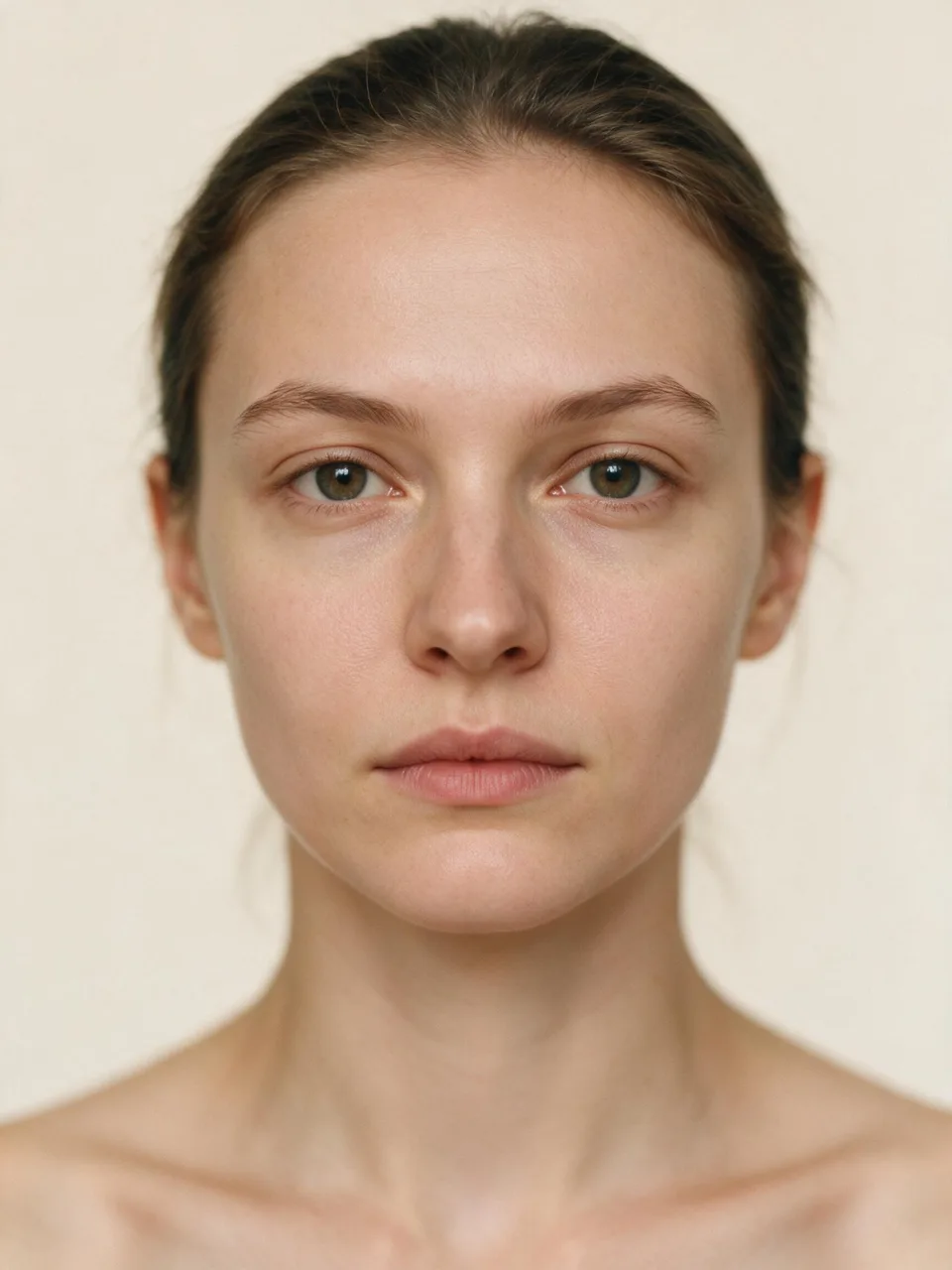
EXAMPLE ANALYSIS: 478 LANDMARKS MAPPED ON A SAMPLE PHOTO, NOT YOURS.
What a reading looks like
Real components · sample dataA starting line, not a verdict.
What we won't show you: a confidence band (not until our test-retest study ships) · a percentile (not until a reference population is published) · a skin score from one photo (lighting lies). Every "not scored" comes with its reason.
Eye shape is decided by three readings: how visible your eyelid crease is, the angle of your eye corners, and your eye's width against its height. Those readings sort most eyes into six named classes.
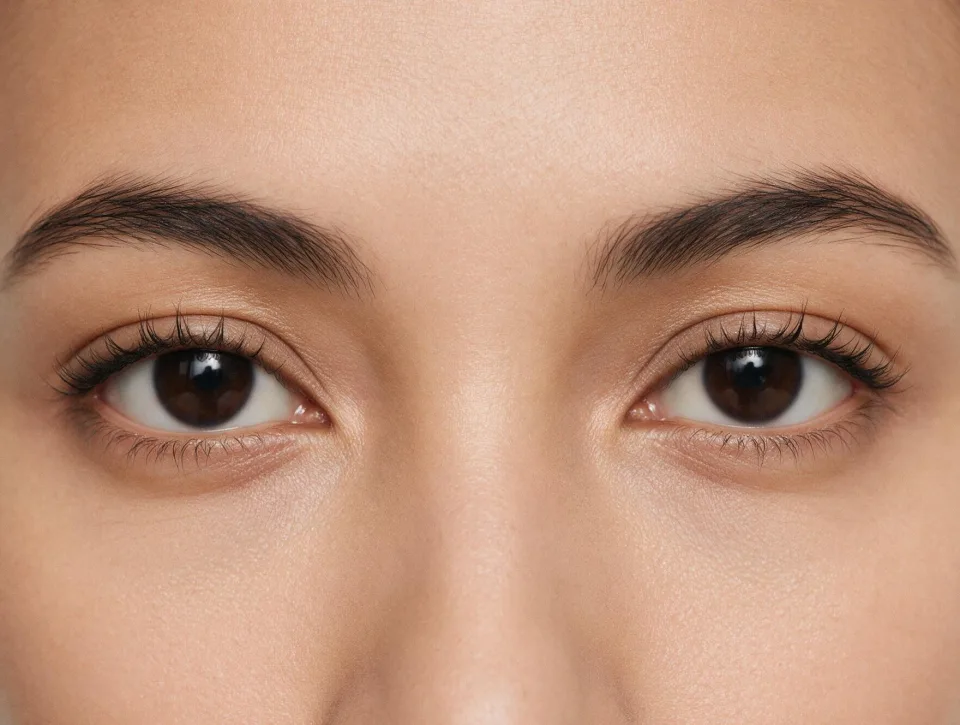
This page is part of our AI facial analysis, and it defines every class by measurement, with a self-check you can run in a mirror. Your free scan reads 478 landmarks on your device and scores the symmetry of the eye region today; the eye shape class itself, with the three readings behind it, is measured in your Attractiveness Report. A class is a description, not a verdict.
The Short Version
The Three Readings That Decide Eye Shape
Three measurements decide an eye shape class: crease visibility (how much lid platform shows), corner angle (whether the outer corner sits above or below the inner one), and the width-to-height ratio of the eye opening.
The eye opening, the palpebral fissure in clinical language, is wider than it is tall in every published adult sample. In 200 South Indian adults aged 18 to 26, it averaged about 30 to 31 mm wide against 11 to 12 mm tall, roughly two and a half times wider than tall, with corners tilted a few degrees upward on average. Every class below is a different way of departing from that baseline.
Reading one: crease visibility
Crease visibility separates the almond and round family from hooded and monolid eyes. The crease is the fold where the lid doubles as the eye opens; the lid platform is the strip of skin between crease and lash line. A hooded eye has a crease with soft tissue above it draping over the platform. A monolid has no crease line at all. Both are ordinary anatomy with published numbers behind them: in one Malaysian study, every Malay volunteer and 70.1% of Chinese volunteers had a crease on both eyes, with mean crease heights of 8.33 mm and 4.91 mm. Crease height and pretarsal show also differ by race, sex and age in the American sample that measured them.
Reading two: corner angle
Corner angle separates upturned from downturned eyes, and it is the one reading with its own instrument on this site. The angle of the line from inner corner to outer corner is your canthal tilt: positive means the outer corner sits higher, negative means it sits lower. That free tool measures the angle in degrees, per eye, on your device. Upturned is a positive tilt and downturned is a negative one, so this mirror question has a number behind it.
Reading three: width against height
Width against height separates almond from round. An almond eye is clearly wider than tall, and its outline tapers toward both corners. A round eye carries more height for the same width, holds a more open curve, and often shows white above or below the iris. Depth is the quiet fourth reading: deep-set eyes sit farther back in the orbit, under a stronger brow shadow. Depth is also the reading a flat photograph handles worst, which is worth remembering before you accept any 2D verdict about it.
The Six Eye Shapes, Defined by Measurement
Each eye shape is defined by which reading departs from the baseline, and the table states that reading for all six classes, plus monolid, which earns its own row because a crease reading is not an outline reading.
| Eye shape | Defining reading | What you see straight on | Often confused with |
|---|---|---|---|
| Almond | Visible crease; width well above height; outline tapers to both corners | A clear lid platform and pointed corners | Round, upturned |
| Round | Visible crease; height high for the width; the curve stays open at the corners | White showing above or below the iris | Almond |
| Hooded | Crease present, with a fold above it covering the lid platform | Little or no platform shows while the eyes are open | Monolid, deep-set |
| Monolid | No crease line on the lid | A smooth lid from lash line to brow | Hooded |
| Upturned | Outer corner sits above the inner corner: a positive canthal tilt | Corners rising toward the temples | Almond |
| Downturned | Outer corner sits below the inner corner: a negative canthal tilt | Corners settling toward the cheeks | Hooded |
| Deep-set | Eye sits farther back in the orbit, under a projecting brow | A shadowed upper lid and a prominent brow bone | Hooded |
Real eyes hold more than one label at once. Hooded and downturned describe different readings, so one eye can be both, and a chart that forces a single answer is rounding you to its nearest row. When two rows fit, read the crease first and the corner angle second.
How to Find Your Eye Shape With a Mirror and a Photo
You can find your eye shape in about two minutes with one straight-on photo and three checks.
- Photograph your face straight on with the lens at eye height, expression flat, hair clear of both eyes.
- Check the crease: a visible lid platform points to almond or round, a fold covering the platform reads hooded, no crease line reads monolid.
- Check the corners against a horizontal drawn between your two inner corners: outer corners above it read upturned, below it downturned.
- Compare width to height: closer to three times wider than tall, with tapered corners, reads almond; taller and more open reads round.
- Check depth in side light: a strong brow shadow across the upper lid points to deep-set.
Write down every label that fits rather than the one you were hoping for. The corner check is the one you never have to eyeball, because the canthal tilt tool returns it in degrees while you wait.
What the Free Scan Measures Around Your Eyes
The free scan measures the symmetry of your paired eye landmarks today, and it does not print an eye shape class. What it does measure is real and checkable: it maps 478 landmarks in your browser, scores symmetry against a fitted midline, and uses your eye width as the ruler for its facial fifths reading. Symmetry, thirds, fifths, golden ratio proximity and harmony come back scored in about a second, and photos never leave your browser. The full face analysis explains all five components in one place.
The classification itself (crease show, corner angle in degrees, and width against height, resolved into a named class) is measured in your Attractiveness Report, beside every other measurement and the weight each one carries.
What the Evidence Says About Eye Shape and Attractiveness
The evidence says less than the internet does: no published study ranks the six eye shape classes against each other. The rating literature that exists measures continuous features, mostly corner angle, on edited photographs, and its two strongest studies point in opposite directions: the same kind of edit one panel preferred, another panel marked down. Those studies sit, with citations, on the canthal tilt page.
Population norms are just as unhelpful to a verdict. Fissure dimensions and inclination differ by sex and by population in every sample that measured them, so most attractive eye shape is a question with no stable reference group. An industry that retires eye shapes every few seasons has still not agreed on a winner. Measurement is slower, and calmer.
Can You Change Your Eye Shape?
You cannot change your eye shape at home, because the orbital bone, the canthal tendons and the lid structures that set all three readings do not respond to exercise or massage. What changes is the read: liner, lash and brow work shift how crease and corner register in a photograph, and eyeliner matched to your canthal tilt covers the technique. Hooding also drifts slowly with age as the soft tissue above the crease descends. Eyelid surgery exists and belongs with a qualified clinician after an examination: a lid that droops suddenly, changes on one side only, or gets in the way of vision is a question for that clinician, not for a chart.
What This Score Cannot Tell You
The measurement conventions and the failure modes sit in how we measure, and where the measurement fails.
You Know Your Eye Shape: What Next?
Treat the label as one photograph's answer and confirm it before you act on it: retake the photo at eye level in different light, and keep every label that survives both frames. The corner reading is the one worth pinning down in degrees, since it moves with camera height. And a class is not a score: what a 1-10 attractiveness score really means covers that scale separately, including what your score means and what it cannot.
Not medical advice. This is a chart and a measurement method for a photo, not a diagnosis, a clinical assessment, or a verdict on you.
It measures geometry, not worth. The number tells you where you start. It never tells you what you are.
on every page
of this site
Your report, in full.
- Side profile
- Skin, measured properly
- Averageness
- Dimorphism
- Ranked plan
Paid photo deleted within 24 hours · never used for training
- 40+ measurements, 7 regionsPP. 2-9
- Side profile, from a second photoPP. 10-13
- What moved your score, rankedPP. 14-16
- Four week plan and day 30 re-scanPP. 17-20
Frequently Asked Questions
What eye shape do I have?
You find your eye shape with three checks: crease visibility, corner angle and width against height. A visible lid platform with tapered corners reads almond, a covering fold reads hooded, no crease reads monolid, and outer corners above or below level read upturned or downturned.
What is the most attractive eye shape?
No published study ranks the six eye shape classes, so no measured answer exists. The nearest literature rates corner angle on edited photographs, and its two strongest studies point in opposite directions. A class describes geometry, not appeal.
What is the rarest eye shape?
No population census of the six classes exists, so every rarity ranking you have read is chart lore rather than measurement. Crease presence is the one reading with published prevalence, and it varies sharply by population: all Malay and 70.1% of Chinese volunteers in one study had a crease on both eyes.
What are hooded eyes?
Hooded eyes have a crease with a fold of soft tissue above it that drapes over the lid platform, so little of the lid shows while the eyes are open. It is ordinary anatomy, and it becomes more common with age as the soft tissue above the crease descends.
Is a monolid an eye shape?
A monolid is a crease reading rather than an outline: the lid runs smooth from lash line to brow with no crease line. Most charts list it as its own class, and its prevalence varies widely by population: 29.9% of Chinese volunteers in one Malaysian study had no double eyelid, against none of the Malay volunteers.
Are upturned eyes the same as a positive canthal tilt?
Yes. Upturned is the everyday word for a positive canthal tilt and downturned for a negative one, the same corner angle in degrees. The canthal tilt tool on this site measures it live, per eye, on your device.
Can eye exercises change my eye shape?
No. The orbital bone, the canthal tendons and the lid structures that set the three readings do not respond to exercise or massage, and no published trial shows otherwise. Makeup changes how the shape reads; nothing you do at home changes the shape.
Do eyes change shape with age?
The outline stays put while crease visibility drifts: soft tissue above the crease descends over decades, so eyes read more hooded with age. The American sample that measured eyelid dimensions across ages 20 to 80 found cohort differences in fissure and brow measurements.
What are hunter eyes?
Hunter eyes is subculture shorthand for a bundle of four traits: low eyelid exposure, deep-set orbits, a close brow and a positive canthal tilt. Only the tilt is a single measurement, and the bundle as a whole has no standard definition in the published literature.
Does the free scan tell me my eye shape?
No, and it does not pretend to. The free scan scores symmetry, thirds, fifths, golden ratio proximity and harmony on your device, with nothing uploaded, stored or used for training. The eye shape classification is measured in your Attractiveness Report.
References
Every claim above, traceable
- Vasanthakumar, Kumar and Rao, Oman Medical Journal 2013 - palpebral fissure width averaged 31.08 mm in men and 29.90 mm in women, against heights of 11.30 and 11.58 mm, across 200 South Indian adults aged 18 to 26.
- Lu, Kadir, Ngeow and Othman, Scientific Reports 2017 - all 103 Malay and 70.1% of 97 Chinese volunteers had a double eyelid on both eyes, with mean upper eyelid crease heights of 8.33 mm and 4.91 mm.
- Price et al., Plastic and Reconstructive Surgery 2009 - crease height, pretarsal skin height and palpebral fissure dimensions differed by race, sex and age across 89 African American and 75 white adults aged 20 to 80.