AI Canthal Tilt Test: Positive, Negative, or Neutral?
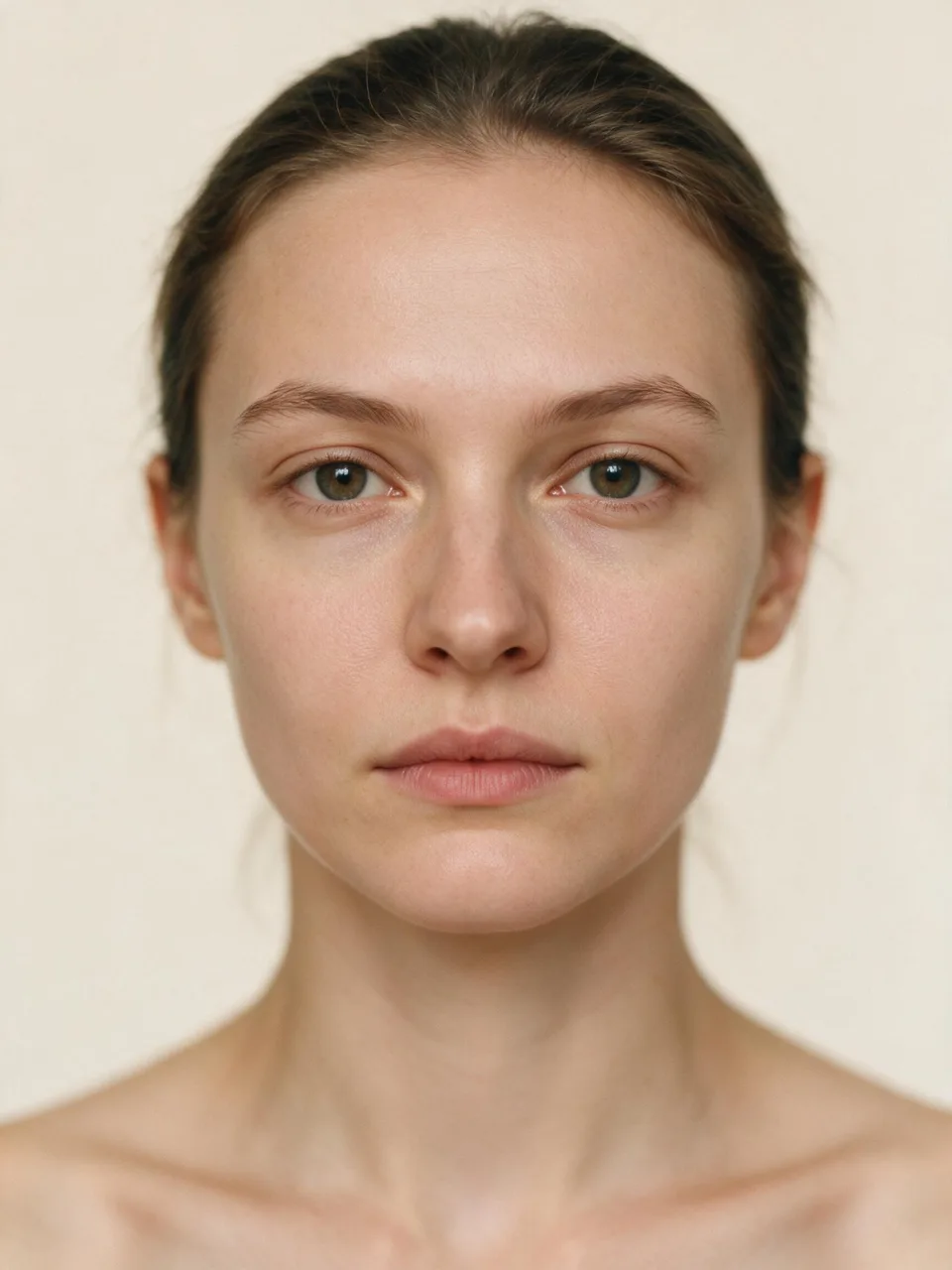
EXAMPLE ANALYSIS: 478 LANDMARKS MAPPED ON A SAMPLE PHOTO, NOT YOURS.
What a reading looks like
Real components · sample dataA starting line, not a verdict.
What we won't show you: a confidence band (not until our test-retest study ships) · a percentile (not until a reference population is published) · a skin score from one photo (lighting lies). Every "not scored" comes with its reason.
Canthal tilt is the angle between the inner and outer corner of the eye. Positive tilt means the outer corner sits higher; negative means it sits lower; neutral means they are level.
This AI facial analysis measures that angle in degrees from your photo, per eye, on your device. An angle is a description, not a verdict.
The Short Version
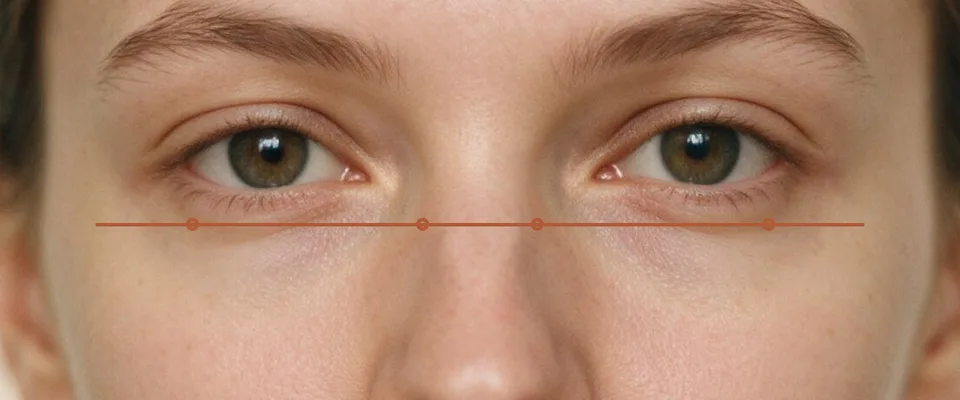
Canthal tilt is a small number measured between two landmarks per eye: the inner corner and the outer corner against level. Degrees, not vibes. A positive value means the outer corner sits higher, a negative one means it sits lower, and the scan reports the angle it actually measured on your photo.
What Is Canthal Tilt?
Canthal tilt is the angle of the line from the medial canthus (inner eye corner) to the lateral canthus (outer eye corner), read against a horizontal drawn across the face. Positive degrees mean the outer corner sits higher.
The medial canthus is where your upper and lower lids meet beside the nose. The lateral canthus is where they meet at the outer edge, anchored to the orbital rim by the lateral canthal tendon. The line joining them is the intercanthal axis, and its angle against the face horizontal is the measurement. That reference runs across your face, not across the photograph, which is why a tilted camera changes the picture and not the eye. Eye tilt, canthal angle and palpebral fissure inclination name the same quantity.
What Is a Positive Canthal Tilt?
A positive canthal tilt means the outer corner of the eye sits higher than the inner corner, reported here as a positive number of degrees. The sign covers everything above zero, so 1 degree and 9 degrees are both positive tilt and are not the same eye. Most published adult averages sit above zero. Upturned eyes is the mainstream word for it.
What Is a Negative Canthal Tilt?
A negative canthal tilt means the outer corner of the eye sits lower than the inner corner, reported here as a negative number of degrees. The sign describes direction, not severity: negative tilt starts anywhere below zero and runs from a fraction of a degree to a clearly downward set. Downturned eyes is the everyday word for it. A negative reading records where two landmarks sat in one photograph, and the studies that weigh that come later.
What Is a Neutral Canthal Tilt?
A neutral canthal tilt means the two corners sit level, or close enough to level that the measurement cannot separate them. Near is doing real work there: a 2D estimate close to zero crosses the boundary on camera height alone, so a neutral result and a slightly positive one are often the same eye twice.
Positive vs. Negative Canthal Tilt: What's the Difference?
The table sets the three types side by side, with the sign each carries and what each reading leaves unsaid.
| Type | Where the outer corner sits | Sign in degrees | Common informal names | What it does not tell you |
|---|---|---|---|---|
| Positive canthal tilt | Higher than the inner corner | Above 0 | Upturned eyes, cat eyes | How much eyelid you show, or how the eye reads in motion |
| Negative canthal tilt | Lower than the inner corner | Below 0 | Downturned eyes, puppy eyes | Your eye shape, your orbital depth, or how anyone reads your face |
| Neutral canthal tilt | Level with the inner corner | At or near 0 | Level eyes, straight-set eyes | Which side of zero a second photo would put you on |
Positive and negative canthal tilt differ in one thing: the sign of a single angle. The gap between the two categories is often smaller than the error in one photograph, which makes positive vs negative canthal tilt a finer comparison than the labels suggest. Someone at plus 1 degree and someone at minus 1 degree share more eye geometry than two people who both measure plus 6. Shot from below, positive canthal tilt vs negative swaps inside one sitting, and negative canthal tilt vs positive swaps back at eye level.
How Your Canthal Tilt Is Measured, in Degrees
This test measures canthal tilt from four eye-corner landmarks and five midline points on a 478-point face mesh. The mesh runs inside your browser, which is why photos never leave your browser. A face-horizontal axis is fitted through the midline points, and each eye's intercanthal line is projected against it. The result comes back per eye and averaged, beside the raw uncorrected angle, so the roll correction is visible rather than asserted.
You can measure your own canthal tilt without any tool, using a phone, a straight edge and four steps.
- Photograph your face straight on with the lens at eye height, chin neutral, hair clear of both outer corners.
- Mark the inner corner and the outer corner of one eye, where the upper and lower lids meet.
- Draw your reference horizontal along the line between your two inner corners, not along the edge of the photo.
- Measure the angle between the corner-to-corner line and that horizontal, then repeat on the second eye and average the two.
Both routes return a 2D photo estimate against a fitted face axis. Neither is the clinical measurement, which is read against the Frankfort horizontal plane with the head positioned, and a photo estimate does not replace it.
What Is a Normal Canthal Tilt? Average Angles by Sex and Population
No single normal canthal tilt exists. Published averages for young adults run from under 1 degree to about 8 degrees of upward tilt, and the mean moves with the population measured and the method used.
Two conventions are in play here, and mixing them is the most common error online. Fry reports tilt directly, in degrees of inclination above a horizontal drawn from the inner corner. Gao reports a three-point angle where 180 degrees means level, so 177.6 degrees is 2.4 degrees of tilt. Both point the same way: East Asian samples measure more upward tilt than white samples, and female means sit above male means.
| Study | Population | n | Sex | Reported angle |
|---|---|---|---|---|
| Fry 2017 | Non-Latino white adults, 18 to 39 | 18 | Both | 2.5 degrees of lateral canthal inclination |
| Fry 2017 | Latino adults, 18 to 39 | 32 | Both | 6.0 degrees of lateral canthal inclination |
| Fry 2017 | East Asian adults, 18 to 39 | 18 | Both | 8.0 degrees of lateral canthal inclination |
| Gao 2025 | Caucasian adults, 18 to 30 | 101 | Male / female | 179.2 ± 2.8 and 177.6 ± 2.6 (0.8 and 2.4 degrees of tilt) |
| Gao 2025 | Chinese adults, 18 to 30 | 46 | Male / female | 175.1 ± 3.0 and 174.0 ± 2.9 (4.9 and 6.0 degrees of tilt) |
| Liu 2023 | Caucasian celebrities aged 23 to 42 | 42 | Female / male | 8.50 ± 2.10 and 6.51 ± 2.67 degrees of canthal tilt |
Every row names its population and its sample size, because a degree value without its sample is the error this page exists to avoid. Liu sets those celebrity means against a 4.12 degree Caucasian average reported by Rhee.
Canthal tilt in men and women
The measured sex difference is real and small. Liu and colleagues measured 21 female and 21 male Caucasian celebrities and reported 8.50 degrees of canthal tilt in the women against 6.51 degrees in the men, at P below .010. Those 42 faces were picked for their attractiveness from editorial rankings, which makes them selected faces rather than a norm. Gao's population sample points the same way with a smaller gap: 2.4 degrees for Caucasian women, 0.8 for the men.
What the celebrity datasets actually measured
The celebrity numbers circulating online come from one paper. Liu, Salinas and Sharaf ran 100 facial landmarks across 42 Caucasian celebrities aged 23 to 42, selected from editorial rankings between 2017 and 2022, from frontal photographs with no facial animation. It licenses one claim: that this group of selected faces measured these angles. A correction in November 2023 fixed an error in male interpupillary distance and left the tilt values standing. We do not publish the canthal tilt of any named person.
What the Evidence Says About Canthal Tilt and Attractiveness
Bashour and Geist produced the strongest single effect in this literature: female faces with an accentuated medial canthal tilt were preferred 93% of the time over the unmodified original, at p below 0.0001. Judges made a forced choice between two versions of the same face, one edited in Photoshop. That licenses one claim, that raters detect and prefer the edit, not the claim that your tilt sets how attractive your face is.
Kempa and colleagues tested the opposite direction and found the opposite sign. Across 2,081 participants rating nine edited versions of one unisex face, raising the lateral canthus lowered ratings of attractiveness, femininity and trustworthiness, and raised dominance, threat and disgust. Two careful studies pointing opposite ways is the honest state of the question.
Sforza and colleagues compared groups instead of edits, digitizing landmarks on 126 attractive Italian subjects recruited at beauty competitions and 199 normal subjects aged 18 to 30. The attractive group measured increased eye fissure inclination, reduced intercanthal width and longer eye fissures. The paper reports z-score patterns rather than degrees, so it supports a group difference, not a threshold a face passes.
Vaca and colleagues bound all three findings with a camera. Twelve volunteers were photographed with the Frankfort plane set between minus 15 and plus 15 degrees, and 11 blinded evaluators ranked the results. Downward head tilt tracked with better aesthetic ranking at rho = 0.901, and positive intercanthal tilt grew more pronounced as the head tilted down, at P below 0.001. Head position moves the angle and the rating together.
Is a Negative Canthal Tilt Bad? Is a Positive One Better?
A negative canthal tilt is ordinary anatomical variation, and neither direction is better in any sense a measurement supports.
The population data puts the question in proportion. Published adult means sit within a few degrees of level, with standard deviations of roughly 2 to 3 degrees. Most of any measured group lands close to zero, and the rest spreads to both sides. The question became common through a short video format that pairs a filter with a verdict, and the filter has no reference population. The research that exists reports preferences in rating tasks on edited images: a face is altered, raters rank the versions, the difference is recorded. That is a finding about edits and raters, not a rule about faces, and it says nothing about how a face reads across a conversation.
Hunter Eyes, Upturned, Downturned: The Other Words for Tilt
Upturned and downturned are the mainstream words for positive and negative canthal tilt, and they map onto the measurement cleanly. Hunter eyes does not: it bundles four traits, and canthal tilt is one of them. The other three are low eyelid exposure, deep-set orbits and a close brow, all named here as not measured. A separate guide covers looksmaxxing, and what the terms mean.
- Upturned eyes: the mainstream word for a positive canthal tilt, same measurement, different register.
- Downturned eyes: the mainstream word for a negative canthal tilt, and the phrasing most makeup guides use.
- Hunter eyes: a bundle of four traits rather than a synonym, of which tilt is the measured one.
Can You Change Your Canthal Tilt?
You cannot change your canthal tilt at home, because the lateral canthal tendon anchors to the orbital bone and neither one responds to exercise. Three tiers of claims circulate, ranked here by what the evidence supports.
- What changes how the tilt reads: eyeliner for a negative or positive canthal tilt, lash placement and brow shape, which work immediately and change the read rather than the angle.
- What changes nothing: eye exercises, squint training, facial massage and mewing claims applied to the eye region, none with published evidence of moving a canthal tendon.
- What sits outside this page: canthoplasty and canthopexy, real oculoplastic operations that belong with a qualified surgeon after an examination, with no procedure or cost detail here.
The honest answer to fixing a negative canthal tilt without surgery is the first tier and nothing past it: the read changes, the angle stays.
What This Score Cannot Tell You
The band derivation and the failure modes sit in how we measure, and where the measurement fails.
You Know Your Type: What Should You Do With It?
The type you just found out you are describes one photograph, and it raises three practical questions: whether the reading holds, what can change, and what cannot. Confirm the number before you act on the label. The three sections below take those in order.
Your band names which of the three types the angle falls into. Degrees are not the site's 1 to 10 scale, which what a 1-10 attractiveness score really means covers separately.
How to confirm it
- Retake the photo with your rear camera, lens at eye height, chin neutral, in the same light as the first.
- Keep your hair off both outer corners and your expression flat, since squinting moves the outer corner landmark.
- Measure the new photo and note both averages along with the roll delta the result shows.
- Compare the two angles rather than the two labels, and read the spread between them as your real margin.
Three photos give a more honest spread than two. When they disagree, the photograph is the variable.
What it changes
Makeup and brow placement change how the tilt reads in a photograph and to a viewer, and nothing else. Liner drawn past the outer corner and angled upward extends the visual line of the eye. Liner that thickens toward the outer third does it more quietly. Brow shape sets the frame the corner is read against. All three are changes to the read, not to the angle: measure again with the makeup on and the number is unchanged. A separate guide covers the eyeliner techniques, step by step.
What it does not change
The angle itself stays put. The lateral canthal tendon attaches to a bony tubercle inside the orbital rim, and bone and tendon answer to neither exercise, massage nor routine. Soft tissue around the lateral canthus does shift slowly across decades. Canthoplasty and canthopexy reposition the tendon surgically, the only entry here that moves the measurement, and they belong with a qualified surgeon.
Is the Canthal Tilt Test Accurate?
The canthal tilt test is reproducible: the same photo and the same version return the same angle, which is a narrower claim than being right about your face.
Three design choices carry that claim. The result prints the raw image-horizontal angle beside the roll-corrected one, so you watch the correction happen instead of trusting it. The instrument refuses an angle above 5 degrees of pitch or 8 degrees of yaw. It refuses again when hair, lashes or a glasses rim crosses a corner, or when the face sits too small in frame. And what it reports is a 2D photo estimate against a fitted face axis, not a clinical measurement against the Frankfort plane. A percentile and a confidence band stay off the screen until a named reference study exists. The rest is in the method, the version and the test-retest data.
Eye Region Metrics: What Else Is Worth Measuring
The eye corner is one measurement in a region with several: brow position, eye spacing, eyelid exposure and orbital depth. None of them is the canthal angle.
The eye shape detector answers what your eye shape is by classifying the outline of the lid opening: almond, round, hooded or monolid. This page measures the corner angle instead.
The full AI face analysis scores every component at once, and the full attractiveness test is the namesake instrument: 478 landmarks, five components, one 1-10 result.
You have an angle and the distributions behind it. The report ranks your own measurements in the order worth working on and re-scores them on day 30.
Not medical advice. This is a measurement of a photo, not a diagnosis, a clinical assessment, or a verdict on you.
It measures geometry, not worth. The number tells you where you start. It never tells you what you are.
on every page
of this site
Your report, in full.
- Side profile
- Skin, measured properly
- Averageness
- Dimorphism
- Ranked plan
Paid photo deleted within 24 hours · never used for training
- 40+ measurements, 7 regionsPP. 2-9
- Side profile, from a second photoPP. 10-13
- What moved your score, rankedPP. 14-16
- Four week plan and day 30 re-scanPP. 17-20
Frequently Asked Questions
What canthal tilt is most attractive?
No single canthal tilt is most attractive, and the two published rating studies point opposite ways. One found accentuated medial canthal tilt preferred in 93% of forced choices on edited faces; the other found a raised lateral canthus rated less attractive.
What canthal tilt is most common?
The most common canthal tilt in published adult samples is a small upward one, under about 3 degrees in white samples and 5 to 6 degrees in Chinese and East Asian samples. Common is population-specific here, and every one of those means covers young adults only.
How do I find my canthal tilt?
Photograph your face straight on at eye height, mark both eye corners, and measure the angle between that line and a horizontal drawn between your inner corners. The tool on this page does the same in seconds.
Is canthal tilt genetic?
Canthal tilt is largely inherited, because the orbital rim, the canthal tendons and the lid structures that set the angle are products of facial growth. It also shifts as a face develops: one Chinese Han study measured different palpebral fissure inclination in children and in young adults.
Is a positive canthal tilt rare?
A positive canthal tilt is not rare, since most published adult means sit above zero and put a large share of each sample on the positive side. Rare depends on the cutoff: 8 degrees is uncommon in every sample here, 2 degrees is not.
Is it possible to get positive canthal tilt?
You cannot get a positive canthal tilt through exercise, massage or any home routine, because the tendon that sets the angle anchors to bone. Makeup, lash and brow placement change the read only.
Which attractive celebrities have negative canthal tilts?
We do not publish canthal tilt measurements of named people, and no verified dataset of individual celebrity angles exists. The one published study of attractive faces reports 42 Caucasian celebrities as a group: 8.50 degrees for the women, 6.51 for the men.
Is negative canthal tilt unattractive?
A negative canthal tilt is ordinary anatomical variation, and the rating literature does not support calling it unattractive. Those studies rate edited images, which measures an edit rather than a person.
Does canthal tilt change with age?
Canthal tilt changes slowly with age as support around the lateral canthus loosens: in 84 Brazilian women, palpebral fissure inclination measured 19.37 degrees at ages 20 to 40 and 17.79 degrees at 41 to 65. Day-to-day differences are camera height.
Why are my left and right canthal tilts different?
Small left and right differences are ordinary, and part of every gap is measurement noise from head position rather than anatomy. A difference that appeared suddenly, or affects one eyelid only, is a question for an optometrist.
Does my photo get uploaded when I measure my canthal tilt?
No. The face mesh runs inside your browser, so the image bytes stay on your device and nothing is uploaded, stored or used for training. A share card you generate saves the derived numbers only, as the privacy page states.
References
Every claim above, traceable
- Bashour and Geist, Ophthalmic Plastic and Reconstructive Surgery 2007 - female faces with accentuated medial canthal tilt were preferred 93% of the time over unmodified faces (p < 0.0001).
- Liu, Salinas and Sharaf, Aesthetic Surgery Journal Open Forum 2023 - canthal tilt measured 8.50 ± 2.10 degrees in 21 female and 6.51 ± 2.67 degrees in 21 male Caucasian celebrities (P < .010); correction ojad097 published November 2023.
- Kempa et al., Journal of Plastic, Reconstructive and Aesthetic Surgery 2025 - lateral canthus elevation on an edited face lowered attractiveness, femininity and trustworthiness ratings across 2,081 participants.
- Vaca et al., Aesthetic Surgery Journal Open Forum 2022 - across a Frankfort plane range of minus 15 to plus 15 degrees in 12 volunteers, downward head tilt made positive intercanthal tilt more pronounced (P < 0.001) and tracked with blinded aesthetic ranking (rho = 0.901).
- Cai et al., Ophthalmic Plastic and Reconstructive Surgery 2019 - palpebral fissure inclination differed between 310 Chinese Han children aged 7 to 10 and 301 young adults aged 20 to 30.
- Fry et al., Ophthalmic Plastic and Reconstructive Surgery 2017 - lateral canthal angle of inclination measured 8.0 degrees in East Asians, 6.0 degrees in Latinos and 2.5 degrees in non-Latino whites across 68 adults aged 18 to 39.
- Gao et al., Quantitative Imaging in Medicine and Surgery 2025 - 2D canthal tilt measured 179.2 and 177.6 degrees in Caucasian men and women and 175.1 and 174.0 degrees in Chinese men and women, where 180 degrees is level (n = 147).
- Flores et al., Plastic and Reconstructive Surgery Global Open 2019 - in 46 white women across three age groups, the depth of the lateral canthus relative to the medial canthus decreased with age.
- Sforza et al., The Angle Orthodontist 2015 - eye fissure inclination was increased in 126 attractive Italian subjects compared with 199 normal subjects aged 18 to 30.
- Mengoa et al., Brazilian Oral Research 2024 - palpebral fissure inclination measured 19.37 ± 3.28 degrees in women aged 20 to 40 and 17.79 ± 3.24 degrees in women aged 41 to 65 (p = 0.030).
- Rhee, Woo and Kwon, Aesthetic Plastic Surgery 2012 - the biometric eyelid study behind the 4.12 degree average Caucasian canthal tilt figure quoted by Liu et al.