Am I Ugly? The Same Honest AI Face Test
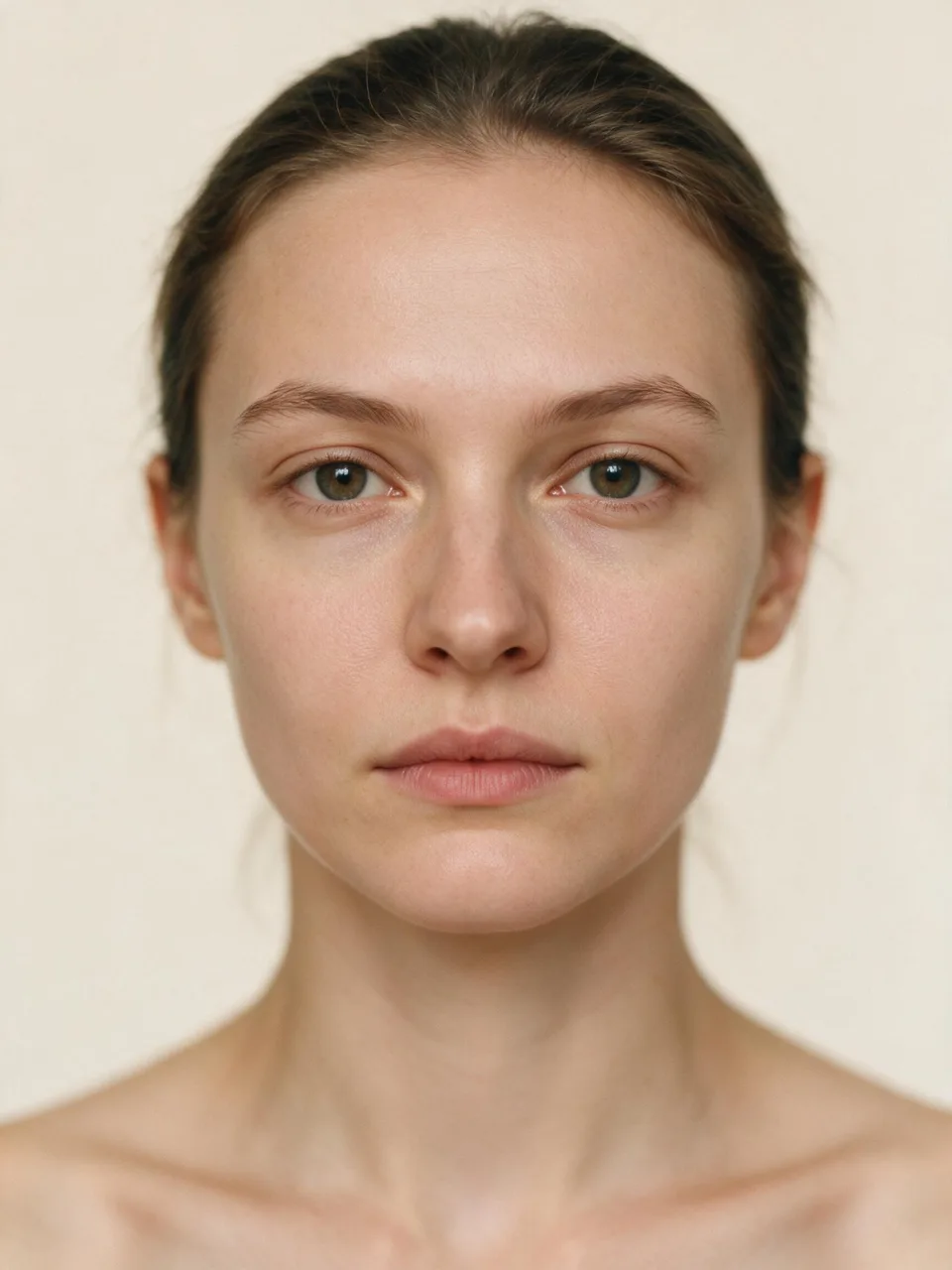
EXAMPLE ANALYSIS: 478 LANDMARKS MAPPED ON A SAMPLE PHOTO, NOT YOURS.
What a reading looks like
Real components · sample dataA starting line, not a verdict.
What we won't show you: a confidence band (not until our test-retest study ships) · a percentile (not until a reference population is published) · a skin score from one photo (lighting lies). Every "not scored" comes with its reason.
Most attractiveness scores land closer to the middle of the scale than to either end, and part of that gap between two close scores comes from the rater, not the face, according to 2018 research in PLOS ONE.
This AI facial analysis runs the same way for everyone: 478 landmarks analyzed on your device, returned as a value on a 1-to-10 scale. It is the same instrument and the same score as the pretty-framed version of this question, with no difference in care.
The Short Version
Am I Ugly?
A measurement can tell you what one photo of your face measures against a published formula. It cannot tell you whether you are ugly, because that is not a property a measurement can find in a face.
The scan measures four things a camera can capture: symmetry, proportion, facial harmony, and apparent age. It compares those measurements to a published formula and returns a value on a 1-to-10 scale. Questions like how ugly am I and do I look ugly are asking for that same measurement in different words, and the answer stays the same regardless of phrasing: a score, the components behind it, and a stated list of what the score does not cover. The scan returns a number, not a verdict, a label, or a description of your face. The number is a starting line, not a verdict on you.

A mirror and a scan hold different kinds of information. A reflection carries the day's light, your expression, and whatever you already feel while looking at it. The scan reads four measurable traits from one photograph, names the conditions that moved them, and stops there. Neither returns a verdict, and the guess-first step lets you compare your own estimate with the measurement, side by side.
Am I Uglier Than I Think?
Self-ratings of attractiveness agree only partly with how other people rate the same face, and people who others rate lower tend to overestimate themselves the most, according to research on self-other agreement.
Here is what the evidence says. A 2020 study in the Scandinavian Journal of Psychology found the gap runs in a consistent direction: people who scored lowest with outside raters overestimated their own attractiveness the most, and people who scored highest underestimated theirs. Independent raters, meanwhile, agree with each other on a given face at a consistency of about 0.78 out of 1.0, a level of agreement reported in a 2018 study in PLOS ONE, which also found that roughly a third of the remaining spread in ratings traces to each rater's individual taste rather than the face itself. The guess-first step built into this scan compares your estimate with the measurement, on your own face, before you see the number, and shows both side by side with no comment attached to either direction.
What the Score Actually Says About Your Face
The score is a value from 1 to 10 that measures symmetry, proportion, facial harmony, and apparent age against a published formula. Where that value ranks among other people is withheld until a reference population exists.
A score answers how one photo measured against a published formula. A percentile answers how that measurement ranks among other people, which needs a stated reference population and its size. A confidence band answers how far one face's number moves between photos, which needs a test-retest study. Neither exists yet at a standard worth printing, so the result shows the value alone and says why. Your attractiveness score is not evidence of how any one person, in any one room, reads your face.
How Do I Know If I'm Unattractive?
A photo answers this with four measurable traits: symmetry, proportion, facial harmony, and apparent age, and nothing else about a face is measurable from a still image.
- Symmetry: how closely paired features mirror each other across the face's midline.
- Proportion: whether facial thirds and fifths sit close to even division.
- Facial harmony: whether the components agree with each other rather than one carrying the score.
- Apparent age: how old the face reads, measured apart from your actual age.
People search this question as are you ugly, are u ugly, and how do I know if I look unattractive, and every version is asking for the same four measurements. This AI facial analysis checks each one from a single frontal photo and stops there. A fifth item does not belong on this list: a face has four traits a camera can measure and a long list of traits a camera cannot.
What Makes a Face Look Uglier in a Photo Than in Person
A face measures differently depending on how the photo is taken, and here is what the evidence says: the shift is often larger than people expect. Camera distance, focal length, lighting direction, expression, head pose, and image sharpness each change what the landmark mesh can see, without changing the face underneath it. Two photos taken minutes apart under different conditions can return two different scores of the same face from the same instrument. None of the five conditions below come from grooming or effort; they come from optics.
| Photo condition | What it changes in the image | Effect on a measured score | What it does not change |
|---|---|---|---|
| Camera distance and focal length | Perspective widens or compresses nearby features as focal length shortens | Shorter focal lengths at close range measurably lower nose and cheek ratios (Trebicky et al., 2016) | The bone structure and proportions in person |
| Lighting direction | Shadow placement across symmetric features | Even, frontal lighting raises measured symmetry scores against harsh side lighting (Roelofs et al., 2022) | The face's actual symmetry |
| Expression | Muscle position around the eyes and mouth | A relaxed, positive expression scores higher than a neutral or negative one (Ho and Newell, 2020) | The face's resting proportions |
| Head pose | Which planes of the face reach the landmark mesh | A frontal pose scores more consistently than an angled or turned pose (Ho and Newell, 2020) | The face itself, only which part gets measured |
| Image sharpness | Edge detail available to the landmark mesh | Blurred images score lower on rated attractiveness (Sano et al., 2025) | The measurements a sharp photo reveals |
The Same Instrument, the Other Question
This page and the am-I-pretty test, same instrument run the identical scan, the identical formula, and the identical score version. The only difference between the two pages is the question a visitor typed into the search bar. The instrument measures the same 478 landmarks, applies the same weights, and returns the same kind of number, whether the question was phrased as a hope or a fear. Nothing about the negative phrasing changes the calculation, the privacy claim, or the tone of the result. A face that scores 6 here scores 6 there, on the same day, from the same photo: same instrument, same number.
"Am I Ugly" Quizzes and Reddit Threads: What They Can Actually Tell You
Three ways of asking this question produce three different kinds of answer, and only one of them has seen your face. A measurement scores the geometry in a photo. A quiz scores your answers to questions about yourself, not your appearance. Posting a photo for strangers to rate collects opinions, and opinions disagree with each other: independent raters agree with each other on facial attractiveness at a consistency of about 0.78 out of 1.0, so any single stranger's rating is one data point from a range, not a settled fact.
| Way of asking | What it actually sees | What it can honestly tell you | What it cannot |
|---|---|---|---|
| A measurement from a photo | 478 facial landmarks | Where the geometry in that photo lands on a fixed scale | How anyone who knows you responds to your face |
| A quiz that never saw your face | Answers about habits and feelings | How you feel about your appearance right now | Anything about your actual measurements |
| Posting your face for strangers to rate | One photo and unlimited opinions | A small sample of individual reactions | A reliable, repeatable score, because raters disagree with each other |
Is the "Am I Ugly" Test Accurate?
The test is reproducible: the same photo, run through the same score version, returns the same number every time.
Reproducible is not the same claim as correct about you. This AI facial analysis measures geometry consistently, on your device, and consistency describes the measurement, not a truth about your worth or your appearance in the eyes of people who know you. The scan states that a formula was applied the same way twice; it does not state that the formula is the final word on a face. The full statistical case for what the formula captures, and where it does not, lives on how we measure attractiveness.
What This Score Cannot Tell You
This score measures one photo, not a face, and six limits bound everything above it.
Where Does an Honest Answer Leave You?
A scan gives you a number; here is what to do with it. The number confirms itself when you retake it under controlled conditions, moves for reasons that have nothing to do with your appearance in person, and stays fixed on some things a photo never touches. The next three sections take those in order: confirming it, what actually changes it, and what does not.
How to confirm it
What your score means, band by band, is explained in full on the same 1-10 scale, explained. Confirming a single result takes three steps.
- Retake the photo with the rear camera at arm's length, in even light.
- Re-run the same score version, without switching devices or apps.
- Compare the two numbers to each other, not the two photos to each other.
What it changes
Three tiers of change act on a measured score, ranked by evidence rather than by how loudly each one is sold.
- Immediate and measurable: photo conditions, covered above, change the score inside a single session.
- Moderate and real: grooming, sleep, and styling shift small proportions and skin presentation, not bone structure.
- Unsupported by evidence: several popular claims promise structural change through exercises or devices, and the research behind them does not hold up; the evidence-ranked improvement guide names each one.
What it does not change
A number does not change how anyone who already knows you sees you. People who know you respond to your expression, your voice, your movement, and your history together, none of which a photo captures. The population reality is plain: a scan measures geometry in an image, and the people in your life were never scoring that geometry to begin with. The score is information about a photo, not a verdict on a relationship.
Where Can I Get Support If This Result Is Upsetting?
If You Asked a Different Question
Three neighboring pages answer three neighboring questions. The same test, neutrally framed runs the identical scan without either valence in the question, for anyone who typed a plain attractiveness test into the search bar. The am-I-pretty test asks the positive-valence version of this exact page and returns the same score from the same build. The face-rating version of this scan exists to rate your face directly, from a photo you already have, rather than to answer a question you are asking about yourself.
Every figure above comes from a named, peer-reviewed source, linked below by DOI or PubMed ID.
Not medical advice. This is a measurement of a photo, not a diagnosis, a clinical assessment, or a verdict on you.
It measures geometry, not worth. The number tells you where you start. It never tells you what you are.
on every page
of this site
Your report, in full.
- Side profile
- Skin, measured properly
- Averageness
- Dimorphism
- Ranked plan
Paid photo deleted within 24 hours · never used for training
- 40+ measurements, 7 regionsPP. 2-9
- Side profile, from a second photoPP. 10-13
- What moved your score, rankedPP. 14-16
- Four week plan and day 30 re-scanPP. 17-20
Frequently Asked Questions
What are signs of ugliness?
There is no measured set of signs of ugliness, because the phrase names a judgment, not a feature a camera can find. A photo measures four specific traits instead: symmetry, proportion, facial harmony, and apparent age.
What is considered an unattractive face?
The phrase names a rating people give a face, not a fixed property the face has on its own. Raters agree with each other more at the extremes of a scale and disagree with each other more in the middle.
How ugly am I?
The measurement returns a value from 1 to 10 against a published formula, not a description with a name attached to the low end. The scale has no bottom category called ugly, or any other verdict word.
Do I look ugly?
A photo shows symmetry, proportion, facial harmony, and apparent age; looking a certain way in a room is a live event with expression, movement, and light that a still photo does not hold. The two are different questions, and only the first one is measurable.
Is there an ugly meter or an ugliness scale?
There is a published 1-to-10 attractiveness scale with disclosed weights, and there is no inverse scale built for the opposite frame. A scale built to measure ugliness invites the exact verdict this instrument exists to avoid.
Am I ugly or just insecure?
A measurement states where a photo scores against other faces; it does not state why you are asking the question tonight. That second question belongs with a person, and the support section above names a free place to start.
Can AI tell if I'm ugly?
An AI facial analysis computes geometric relationships against a published formula, and ugly is not one of the things geometry measures. The model reports a number, never a verdict, because a verdict was never a measurable output.
Does the "am I ugly" test need a photo?
No. The same instrument runs a short question set with no photo, in the same component as the scan. On the photo path, the image is analyzed on your device and never leaves your browser.
Is the "am I ugly" test different for guys and girls?
The computation is identical for every visitor: the same 478 landmarks, the same published formula, the same weights. This version publishes no percentile, so no reference population is applied to anyone's result and there is no separate ranking for guys or girls to differ on.
References
Every claim above, traceable
- Kramer, Mileva and Ritchie, PLOS ONE 2018 - independent raters agree on facial attractiveness at about 0.78, with roughly a third of the remaining variance from each rater's own taste.
- Greitemeyer, Scandinavian Journal of Psychology 2020 - people rated lower by outside raters overestimate their own attractiveness the most; people rated higher underestimate theirs.
- Trebicky, Fialova, Kleisner and Havlicek, PLOS ONE 2016 - camera focal length and distance measurably change depicted facial shape and rated attractiveness.
- Roelofs et al., Ophthalmic Plastic and Reconstructive Surgery 2022 - lighting direction and exposure measurably change rated attractiveness across more than 22,000 rated photographs.
- Ho and Newell, Perception 2020 - face view (frontal versus angled) and expression combine to raise or lower measured attractiveness ratings.
- Sano, Gondo, Osaka and Kawabata, Acta Psychologica 2025 - image blur lowers rated facial beauty and raises rated ugliness; shorter exposure reverses the effect.