Oval and oblong split on two checks: an oval face runs about 1.5 times longer than wide and tapers from cheekbones to jaw, while an oblong face runs longer still, with forehead, cheekbones and jaw near equal width.
These two shapes are the most commonly confused pair in the seven-shape system, because both run longer than they are wide and both end in a soft chin. This page settles the question with the same two measurements the detector uses, then routes you to the styling guide for whichever shape is yours. Face shape here is a styling heuristic sourced from geometry, never a beauty ranking.
The Short Version
The Two Checks That Split Them
Both checks come straight from the four measurements every face shape rests on: forehead width, cheekbone width, jaw width and face length. The first check compares length against width. An oval face reads noticeably longer than it is wide, at about 1.5 times its width. An oblong face runs notably longer again, past the point where the oval ratio sits. The second check reads the sides. On an oval face the cheekbones are the single widest span, and the face narrows gently toward both the forehead and the jaw. On an oblong face no span stands out as widest: forehead, cheekbone and jaw width all sit close to each other, so the sides run straight from cheekbone to jaw instead of tapering.
- Length ratio: about 1.5 to 1 reads oval; notably longer than that reads oblong.
- Widest point: cheekbones clearly widest reads oval; no clear widest point reads oblong.
- Side line: a gentle taper from cheekbone to jaw reads oval; a straight, untapered line reads oblong.
- Chin: both end soft and rounded, so the chin alone cannot split this pair.
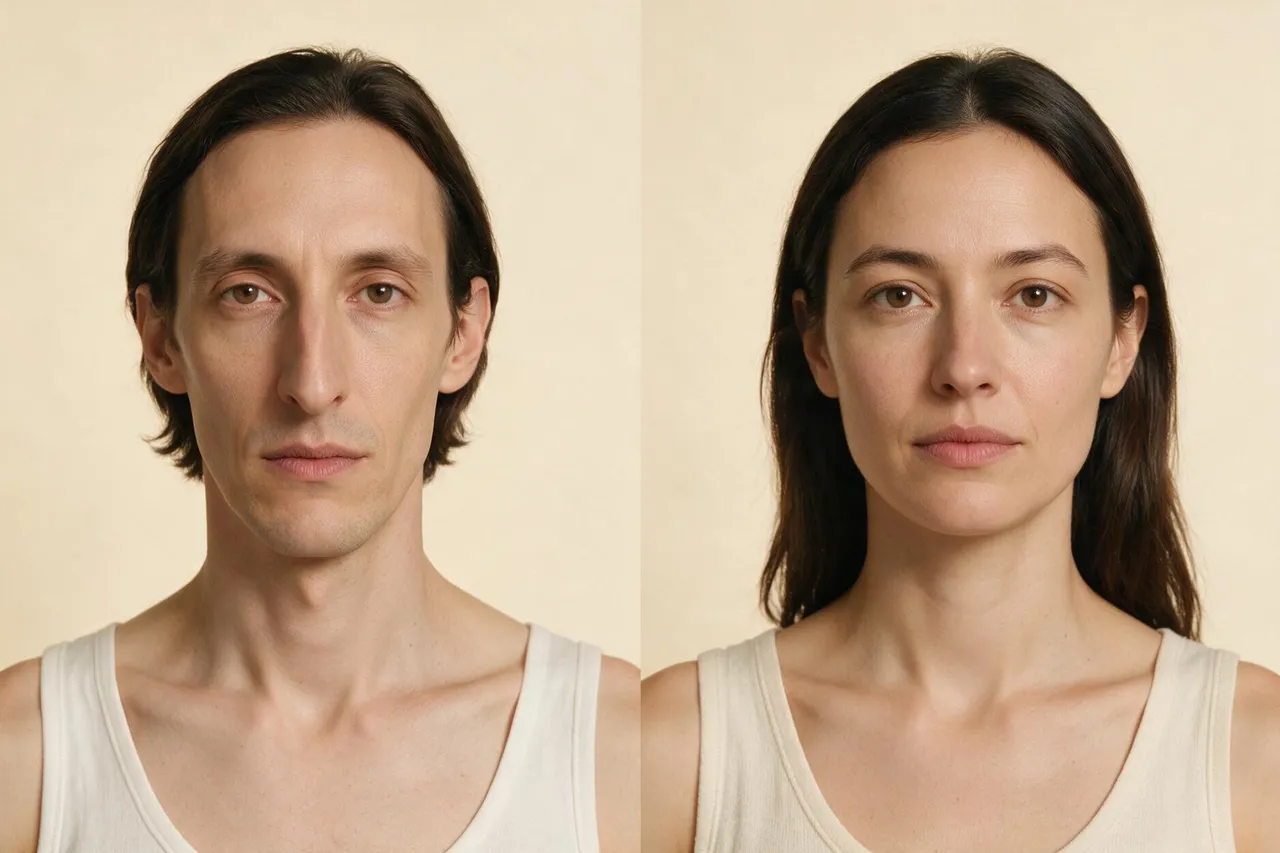
Both checks are visible in this pair. On the left, forehead, cheekbones and jaw run close to one width, the sides drop straight, and the extra length reads oblong. On the right, the cheekbones stand clearly widest and the sides taper toward the jaw, which reads oval. Under identical light the two dividing lines show plainly; in a mirror, on your own face, they rarely do, which is why measuring settles it.
Why This Pair Gets Confused
The confusion has a simple cause: the two shapes share every feature except the two that decide them. Both run longer than wide, both keep a soft jawline with no sharp corner, and both end in a rounded chin. A mirror check reads all of that shared ground and none of the two dividing lines, because a ratio and a width comparison are hard to judge by eye on your own face. Hair makes it worse. A fringe hides the hairline that anchors the length measurement, and volume at the sides can fake the width an oblong face lacks. The measurements underneath do not move with the styling, which is why this question is answered by measuring rather than by looking.
The Borderline Cases
Some faces genuinely sit between the two classes, and the honest answer there is a margin, not a coin flip. A face can carry an oval length ratio with oblong sides, or an oblong length with a visible taper. In those cases the class that wins is the one more of the four measurements agree on, and the losing class is usually close behind. The AI Face Shape Detector handles exactly this situation: it measures all four spans from one front-facing photo, corrects for head tilt on its own, and prints the margin to the next-closest class, so a borderline face gets told it is borderline instead of being forced into a single confident label. The scan runs in your browser and the photo never leaves your device.
What To Do With the Answer
The two shapes style differently, which is the practical reason the label matters at all. An oval face starts balanced, so its styling job is confirming the balance rather than correcting anything. An oblong face carries more length than any other measurement, so its styling job adds width at the sides and cuts the visual sense of length. Once the measurement settles which side you are on, the matching guide carries the rest: the oval face shape guide for the tapered class, and the oblong face shape guide for the straight-sided one.
Not medical advice. This page describes a styling classification from a photo, not a diagnosis, a clinical assessment or a verdict on you.