You have a heart face shape when your forehead is the widest point on your face, your jaw narrows sharply to a pointed chin, and your cheekbones sit between the two.
This guide gives you the checklist, the measurements behind it, six real examples and the styling logic that balances a wide forehead against a narrow jaw. Face shape here is a styling heuristic sourced from geometry, never a beauty ranking.
The Short Version
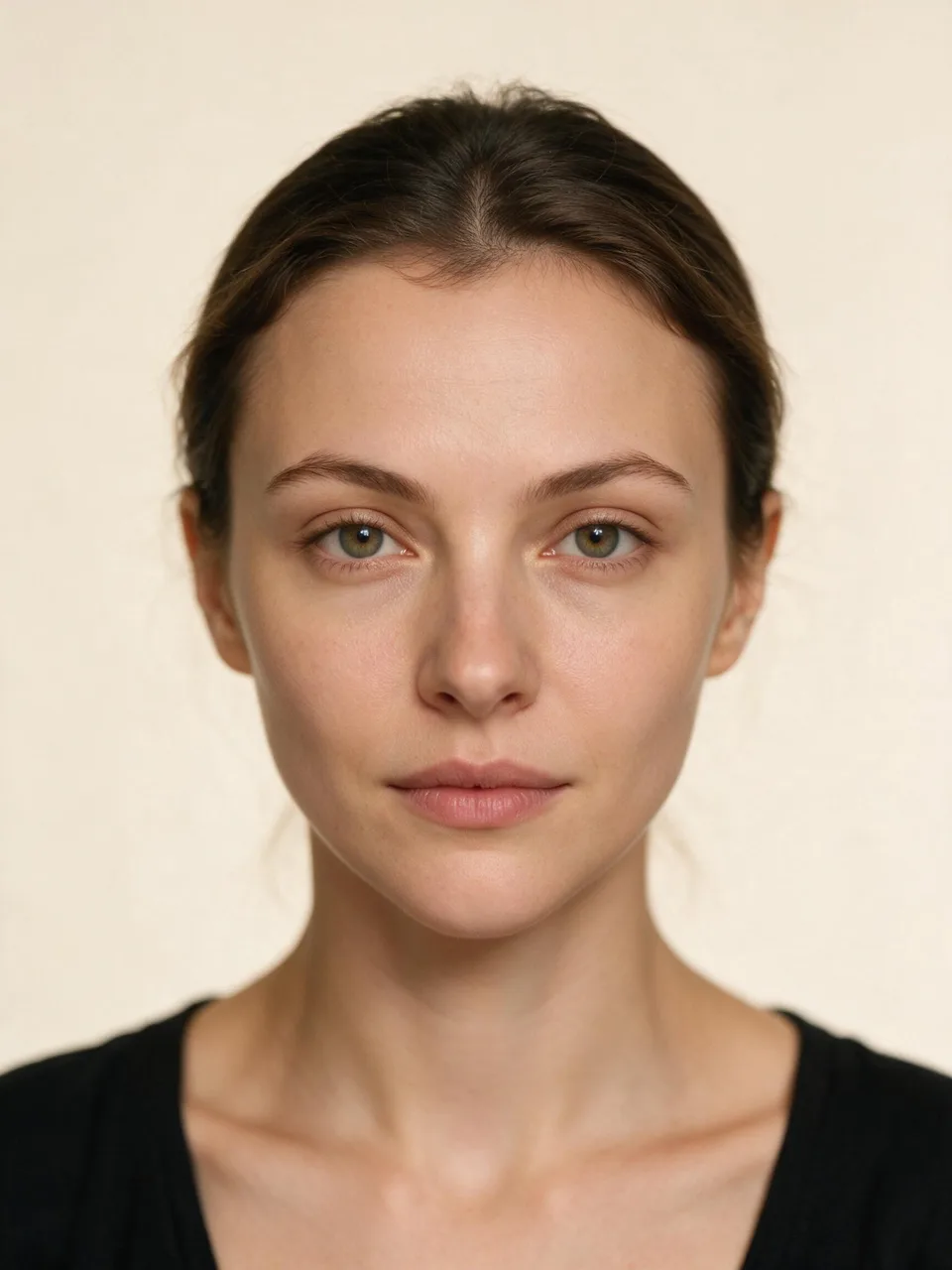
This is the geometry the detector reads, not a style or a look. On a front photo the classifier compares face length against width and the three widths against each other, and the heart pattern is the combination described here. Hair, expression and camera angle change how a face reads to people; they also change the landmarks, which is why the scan asks for a level, front-facing photo.
How to Tell: The Heart Face Checklist
A heart face shape is defined by four measurements, forehead width, cheekbone width, jaw width and face length, and by the ratios between them, not by an outline traced in a mirror. Forehead width sets the reference point on a heart face, because it is the single widest span on a straight-on photo, wider than both the cheekbones and the jaw. From that widest point, the face narrows steadily, first at the cheekbones, then again at the jaw, ending in a chin that reads pointed or visibly narrow rather than square or rounded. That double narrowing, forehead to cheekbones and cheekbones to jaw, is what separates a heart face from every shape where the widest point sits lower on the face. Each criterion below checks one part of that pattern, and a face that satisfies most of them belongs in this class even when one measurement sits close to a boundary.
- Forehead width is the widest measurement on the face, wider than both the cheekbones and the jaw.
- Cheekbone width sits at a mid-point, narrower than the forehead but wider than the jaw.
- Jaw width narrows sharply toward the chin, ending in a pointed or narrow chin rather than a rounded or square one.
- Face length runs in the middle of the range, longer than round but not the measurement that decides this class.
- A widow's peak or a visibly pointed hairline often accompanies the shape, the detail that confirms it fastest.
How Heart Is Different From Diamond and Triangle
Heart is most often confused with diamond and triangle, because all three classes keep the jaw narrower than at least one other measurement. Diamond is the closer mix-up: a diamond face keeps the cheekbones as the widest point, notably wider than both the forehead and the jaw, while a heart face keeps the forehead as the widest point instead. Both classes can end in a pointed chin, so the widest-point test, forehead against cheekbones, is what actually separates them, not the chin shape. Triangle sits at the opposite end of the same pattern: a triangle face flips the entire width order, with the jaw as the widest measurement and the forehead as the narrowest, the mirror image of a heart face's own order. The fastest check across all three compares the forehead directly against the jaw first: a wider forehead reads heart, a wider jaw reads triangle, and a widest-cheekbone reading with a narrow forehead reads diamond.
The AI Face Shape Detector runs this same comparison automatically. Its browser-based landmark mesh measures forehead, cheekbone and jaw width against face length, corrects for head tilt on its own, and applies the same width-order rule to sort a face with the forehead widest and the jaw narrowest into the heart class. It also prints the margin to the next-closest class, a number a mirror check cannot give you.
The Measurements Behind It
Face shape classification rests on four measurements, forehead width, cheekbone width, jaw width and face length, each taken as a straight span rather than an estimate. Forehead width runs across the widest visible point of the forehead, above the temples. Cheekbone width, the bizygomatic width, runs across the face just below the outer corners of the eyes. Jaw width runs from one gonial angle to the other, the points where the jawline turns up toward the ears; on a heart face, that angle narrows sharply rather than holding steady, which is what produces the pointed chin. Face length runs from the hairline to the chin. A heart face carries a forehead measurement wider than both the cheekbones and the jaw, with the jaw reading as the narrowest of the three widths. The most common self-measurement error undercounts forehead width, because hair covers the hairline and the true edge of the forehead gets missed by hand. This AI facial analysis corrects that automatically: it locates the hairline and the browbone edge from the landmark mesh itself, on-device, before a single span is measured.
Heart Faces at a Glance
Six public figures are widely described in mainstream style coverage as having a heart face shape, spanning both long and short hairstyles.
- Scarlett Johansson, styled with soft waves and a deep side part.
- Reese Witherspoon, styled with layered cuts that widen at the jaw.
- Jennifer Aniston, styled with long layers and face-framing pieces.
- Chris Hemsworth, styled with a textured crop and a short beard.
- Bradley Cooper, styled with a side part and a close beard.
- Ncuti Gatwa, styled with a tapered cut and a defined hairline.
For Men and For Women
The four-measurement definition of a heart face shape is sex-neutral: the same width order, forehead widest, jaw narrowest, cheekbones between the two, sorts a face into the heart class regardless of gender. Two presentation differences show up in practice without changing the underlying class. A widow's peak, the pointed hairline that often accompanies this shape, runs more consistently in some family lines than others and can make the forehead read even wider at a glance without changing the actual measurement. Jaw muscle mass also runs higher on average in men, which can soften how sharply the jaw appears to narrow even when the measured width stays the same. Neither difference changes which class a face belongs to; both change how obvious the class looks at a glance.
What Flatters a Heart Face
A heart face carries width at the forehead that no other measurement on the face matches, so the styling job runs opposite to a diamond face: add width and volume lower down instead of higher up. Volume added at the jaw, through a cut that flares slightly at the chin line, a beard filled in along the jawline, or a frame with more width at the bottom, brings the narrowest measurement closer to the forehead's width and evens out the taper. The same principle works against the forehead itself: keeping height and volume low and close to the crown, rather than piled up at the top or swept wide at the temples, avoids adding more bulk to the measurement that is already the widest on the face. The changes to avoid run the other way. A short, choppy fringe cut wide across the brow adds bulk exactly where the face already measures widest, and heavy volume held at the crown does the same from a different angle. A dedicated hairstyle guide for heart faces and a matching glasses guide are both coming; until they publish, the rule above carries the same logic either way, adding width low, keeping width in check up top.
The seven-shape system used across this site is a styling convention rather than a clinical classification, and no published study validates the heart class specifically. Its underlying premise, that face shape needs a measured, repeatable test rather than an eyeballed impression, is supported by research on how people classify faces by sight. Here is what the evidence says about that method: a 2014 study found very low agreement between different viewers, and even the same viewer scoring the same face twice, when face shape was judged by eye, and training did not improve the accuracy.
Not medical advice. This page describes a styling classification from a photo, not a diagnosis, a clinical assessment or a verdict on you.