Frame choice follows contrast: angular frames add the definition round faces lack, curved frames soften square and diamond angles, and the frame front should sit about as wide as the widest part of your face.
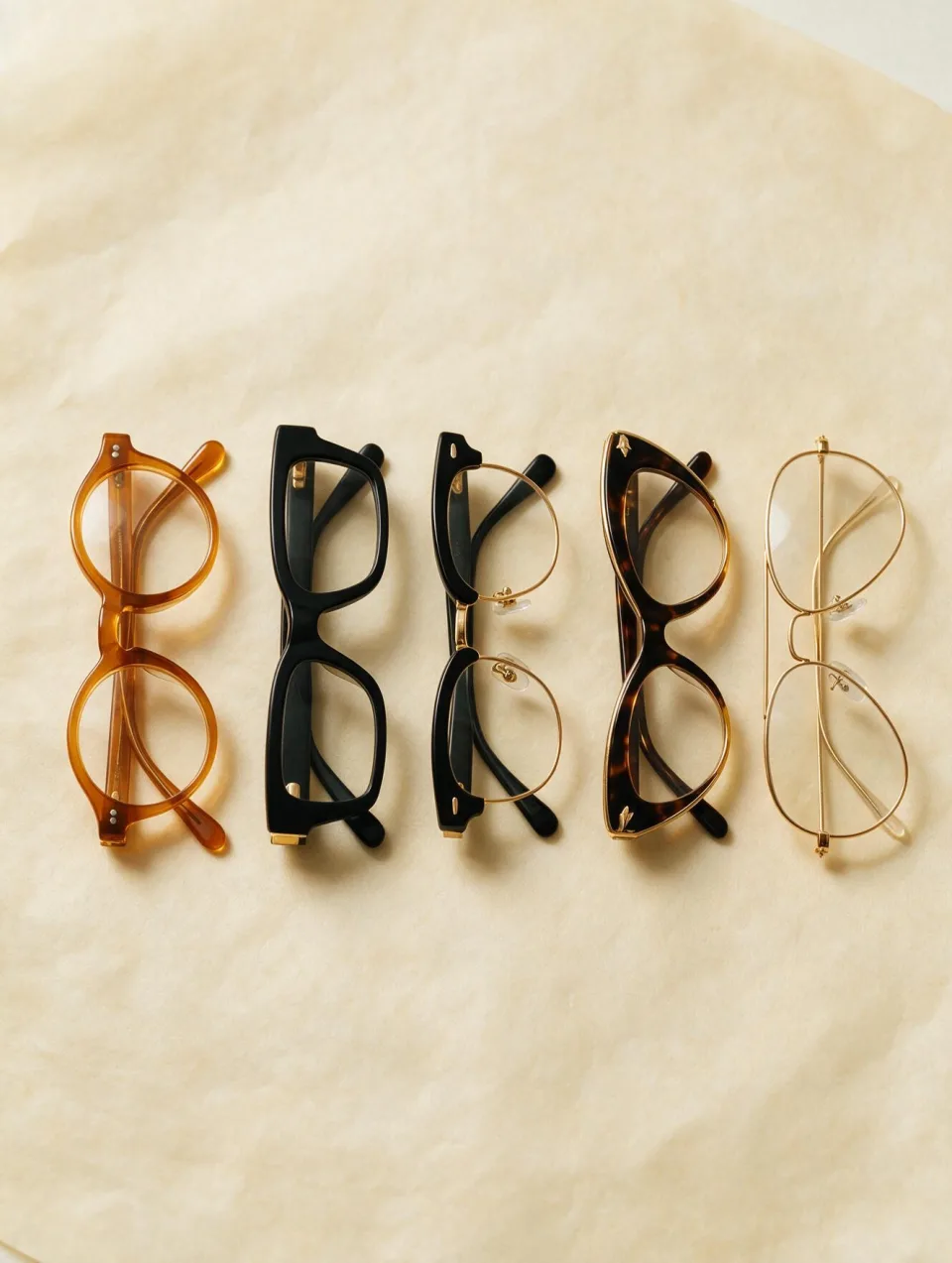
This guide holds the frame logic for all seven face shapes on this site, the fit checks that apply to every pair, and a deeper page for each shape that has one. Face shape is a styling heuristic sourced from geometry, not a beauty judgment: no shape here outranks another, and no frame rule below is a law. Personal taste wins every tie.
The Contrast Rule
The contrast rule says a frame should supply the geometry a face does not already have. A face built on curves gains from corners, a face built on corners gains from curves, and a face that is already balanced gains most from frames that leave its proportions alone. Optician guidance converges on that logic shape by shape: angular frames to lengthen a round face, rounded frames to soften a square jaw, bottom weighted frames to counter a wide forehead [1]. One width rule sits underneath all of it. The frame front should match your face width at the temples, because a frame that runs clearly wider pushes your eyes toward the bridge and reads as borrowed [2]. Everything below is that one rule, applied seven times.
Detect Your Face Shape First
Your face shape comes from four measurements: forehead width, cheekbone width, jaw width and face length. A mirror and a tape can misread those spans by an inch, which is enough to flip a round read into a square one. Instead, detect your face shape from a single photo: the scan runs a 478 landmark AI facial analysis on your device, and your photos never leave your browser. It is the same measurement pass that feeds your Attractiveness Report, used here for one classification only.
Every Shape at a Glance
Seven shapes cover the classification this site uses, and each resolves to a short list of frames that balance it and frames that echo it. The table states the consensus; the sections after it explain the reasoning [1].
| Face shape | Frames that work | Frames that echo |
|---|---|---|
| Round | Rectangle, square, geometric, browline | Small round frames, deep curved frames |
| Oval | Most styles at the right width | Oversized or very narrow frames |
| Heart | Bottom weighted, rimless, thin light rims | Top heavy, decorated brow lines |
| Diamond | Browline, cat-eye, oval, semi-rimless | Narrow frames that pinch at the cheekbones |
| Oblong | Deep lenses, decorative or contrast temples | Small, shallow frames |
| Square | Round, oval, thin metal, semi-rimless | Boxy, hard angled frames |
| Triangle | Browline, cat-eye, aviator, detail up top | Bottom heavy frames |
Glasses for a Round Face
A round face takes angular frames: rectangle, square, geometric and browline shapes add definition that near equal length and width do not supply on their own [1]. Narrow, angular lenses also stretch the face visually longer, which works directly against a round face's close to 1 to 1 ratio. Skip small round frames, which repeat the curve instead of countering it. The full logic, the skip list and the fit checks live in glasses and frames for a round face.

Glasses for an Oval Face
An oval face takes almost any frame at the right width, because its proportions are already balanced and the frame only has to preserve them [1]. Keep the frame front as wide as the widest part of your face, and let taste pick the style: walnut shapes, rectangles and aviators are the classic defaults. The one real miss is an oversized front that swallows the balance. The details sit in glasses and frames for an oval face.

Glasses for a Heart Face
A heart face carries its width in the forehead, so frames balance it from below: bottom weighted shapes, rimless styles and thin, light rims keep visual weight low on the face [1]. A front slightly wider than the forehead evens out the taper toward the chin, and rounded bottom edges soften a pointed chin. Heavy, decorated brow lines push weight the wrong way. The full treatment is in glasses and frames for a heart face.

Glasses for a Diamond Face
A diamond face is widest at the cheekbones and narrower at both the forehead and chin, so frames add presence at the brow: browline shapes, cat-eye lifts and frames with detail along the top rim draw the eye upward and soften cheekbone prominence [1]. Oval and semi-rimless frames keep the middle of the face uncrowded. Narrow frames that pinch against wide cheekbones are the miss. The full logic is in glasses and frames for a diamond face.

Glasses for an Oblong Face
An oblong face runs longer than it is wide, so the frame's job is depth and width: lenses with real vertical depth break up face length, and decorative or contrast color temples add width at the sides [1]. Small, shallow frames do the opposite and leave the face reading longer still. The full skip list and fit checks are in glasses and frames for an oblong face.

Glasses for a Square Face
A square face brings its own angles, so frames supply curves: round, oval, thin metal and semi-rimless styles soften a strong jaw without competing with it [1]. A front that sits slightly high on the nose and runs a touch wider than the middle of the face keeps the jaw in proportion from above. Hard cornered, boxy frames double the angularity. The full logic is in glasses and frames for a square face.

Glasses for a Triangle Face
A triangle face carries its width at the jaw, so frames rebalance it from the top: browline shapes, cat-eye lifts, aviators and frames with color or detail along the upper rim add presence to a narrower forehead [1]. Wide frames help for the same reason, since they broaden the upper third of the face directly. Bottom heavy frames repeat the jaw's weight and are the one clear skip. A triangle face has no separate glasses page on this site: this section is its full treatment, and the triangle face shape guide covers how to confirm the shape itself.
Fit Basics: Width, Eyes and Brow Line
Fit decides more than face shape does, and five checks cover most of it [2]. Every check below applies to every shape in this guide.
- Frame width: the front should match your face width at the temples; a frame that extends clearly past the sides of your face is too wide, and your eyes drift toward the bridge
- Eyes: your pupils should sit centered in each lens, both left to right and top to bottom
- Brow line: the top rim should run below your eyebrows and never cover them; a browline frame traces the brow, it does not replace it
- Cheeks: the frame should sit clear of your cheeks, even when you smile; a pair that lifts on a smile sits too low
- Printed size: lens width, bridge width and temple length are stamped in millimeters inside one temple arm, so note the numbers on a pair that already fits
Sunglasses
Sunglasses follow the same contrast rule as optical frames, shape for shape. The differences are size and coverage: sun lenses run larger by design, so an oversized frame is more forgivable in the sun than at the desk, and larger lenses may cover the brow entirely, which optical frames should not [2]. Match the frame front to your face width first, then apply your shape's rule from the sections above.
The frame guidance on this page is a styling consensus, not a measured outcome. Two named sources carry it here: an eyewear guide reviewed by an ABO certified optician [1] and a frame maker's fitting guide [2]. Both state the same contrast and width logic this page uses. That is what the evidence says about frame choice: opticians agree on the direction, and no controlled trial ranks one frame on one face.
No frame rule here ranks faces. A frame changes how a face reads, not what it is worth, and a face shape read is a starting point for styling, never a verdict on the face.